Mark Wallinger @ Hauser & Wirth, Savile Row – Central
To 7 May: www.hauserwirth.com
 |
| id Painting 12, 2015 - Acrylic on canvas, 360 x 180 cm |
Mark Wallinger’s first solo show for Hauser &
Wirth fills both impressive spaces and gains traction from how several works build
to a vision of the self – not as straightforwardly unified, but rich in variant
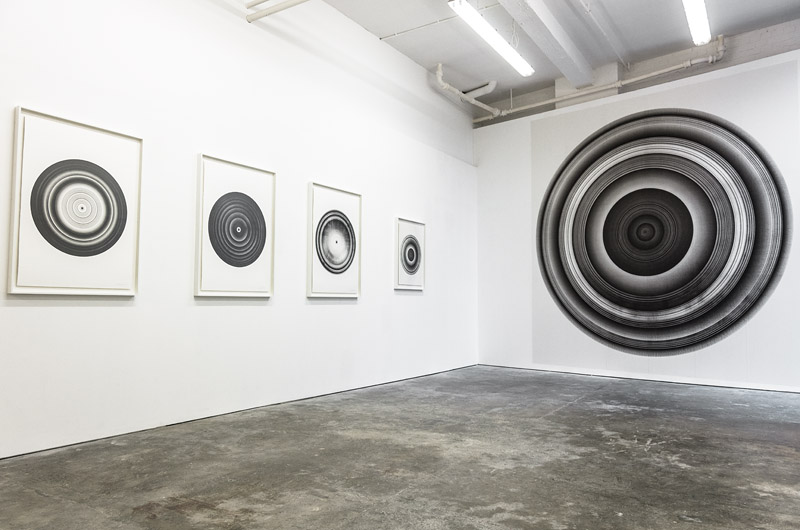
perspectives. One gallery is full of the 3.8m high ‘Id Paintings’ which explore
the tall dark format of Wallinger’s versions of the I from different fonts, but
with expressionist gestures applied with the hand and laboriously replicated in
Rosrchach-like way. The other contains the superego of a giant
mirror revolvingon high, national identity linked to revolving views of an oak
tree on a roundabout in Essex, and the artist as flaneur seen only as the
shadow which precedes him through the city as he walks to experience it.
 |
| Orrery, 2016 - 4-channel video installation, sound |
_________________________
To 7 May: www.foldgallery.com

It
hardly sounds feasible to merge Robert Ryman, Steven Spielberg and
Carlos Cruz-Diez, yet they all came to mind at Finbar Ward’s novel
sculptural installation of 300 small paintings. Ryman as the face of
each is a deceptively painterly monochrome, predominantly white but not
without colour – a framing device of artist-ground cobalt violet.
Spielberg because the obsessive line-up of fin-shaped canvasses brought a
certain film to mind. Cruz-Diez bacause if you walked past the serried
whitenesses then turned back, you saw the scuffed and contingent rear
sides of Ward’s offcuts of found wood, many of them festooned with a
notational ‘b’ for back, setting up a contrast worthy of a
Physiochromie.

________________________
Anna Barriball: New Works @ Frith Street Gallery, Golden Square - Soho
To 7 May: www.frithstreetgallery.com
 |
| Night Window with Leaves, 2015 - Pigment and beeswax picture varnish on paper, 235 x 124 cm |
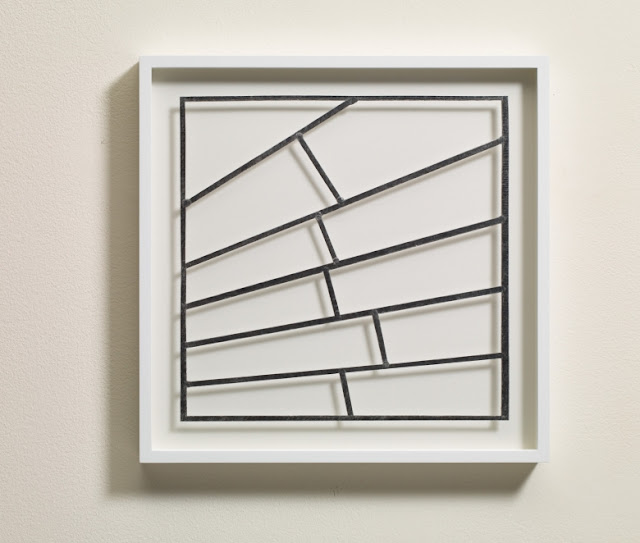
I’ve never seen Anna
Barriball apply her signature frottage with more resonance than here, moving
from morning blinds; to her studio windows, pressed full of light; to a
candle-smoked evening; and through to the first sunrays of a new a diurnal cycle,
taken from lead window designs. She’s in there too, via the sequins on her
T-shirt vibrating to her heartbeat. That suggests ultrasound, and Barriball has
indeed just given birth, setting up a contrast with Night Window with Leaves, which memorialises a former neighbour.
All use the exacting indexical sculpting of a small pencil to press her work up
against the world, as if to avoid, in her words ‘the space between looking and
representation’.
 |
| Sunrays II, 2016 - Pencil on paper, 52 x 53 cm |
________________________
Dunhill and O'Brien: Rockery @ White Conduit Projects, 1 White Conduit Street - Islington
To 30 April: http://whiteconduitprojects.uk (artist talk 21 April)
To 30 April: http://whiteconduitprojects.uk (artist talk 21 April)

A few weeks ago I mentioned in my weekly column that Islington made for a good gallery tour, and that’s still true now * – including this fascinating show which compares the Japanese and British attitudes to rocks. Just as Tracey Emin has confounded the usual relative expectations by marrying a stone, long-time collaborators Mark Dunhill and Tamiko O’Brien ponder two Japanese traditions of rock veneration. They apply Suiseki - the ‘Art of Stone Appreciation’ - to glacial rocks in Britain through a series of videos; and make a window display echoing the nearby Chapel Market out of cardboard versions of the Edo period’s Fujizuka – the construction or selection of surrogates of Mount Fuji for the edification of women then disbarred from the mountain itself. Add a witty ‘surprise yourself with a rock sculpture by doing it blind’ and the show, erm… rocks.
 |
| Stone Appreciation: having discovered ‘celebrity’ rocks by purchasing postcards on the Internet, Dunhill and O’Brien visit and measured these much photographed landmarks, such as the Bowder Stone in Cumbria. |
* it’s worth mentioning Liane Lang & Nigel Grimer at the James Freeman Gallery and Joby Williamson at Tintype
________________________
The Missing: Rebuilding the Past @ Jessica
Carlisle, 4 Mandeville Place – near the Wallace Collection
To 7 May: www.jessicacarlisle.com
 |
| Still from 'The Quake' |
 |
| Piers Secunda: ISIS Bullet Hole Painting (Assyrian Head), 2015-16 - industrial floor paint, metal fixtures |
* see my Feb 2016 choices for a fuller discussion
The Conformist @ Belmacz, 45 Davies St – Mayfair
To 16 April: www.belmacz.com/gallery/
 |
| David Parkinson: Untitled, 1970 |
 |
| Julie Verhoeven: Phlegm & Fluff, 2015, Film, 04:19 |
__________________________
Michael Joo:
Radiohalo @ Blain Southern, 4 Hanover Square – Mayfair
To 9 April:
www.blainsouthern.com

Untitled, To (Sleep), 2015-16 - Silver nitrate and epoxy ink on canvas 91 x 71 cm
Does
this show have the substance to justify its rhetoric and scale?
American Michael Joo is onto something in exploring the body as a
generator and consumer of energy (hence the integration of calorific
values for its actions) combined with the use of silver nitrate to make
painting-come-photographic events which go halfway towards reflecting
our own actions into the scenario. A monumental marble billboard adds
convincing sculptural / architectural language, contrasting the marble’s
own painterly effect on the front with a silvered rear at a height
which brings in the space but not the viewer, and playing reflected
transience off against geological timescale. Yet add in the eponymous
radiohalo, the faultline in New York, Buddhism, and the graphite legs of
endangered cranes scratching drawings over the stairs, and I have
trouble putting it all together coherently - but it’s impressive enough
to be worth puzzling on yourself.
 |
| Installation view with Prologue (Montclair Danby Vein Cut), 2014-15 - picture Peter Mallet |
__________________________
Preview
Special: Having written the catalogue essay for John Stark's
forthcoming show, I can predict it will be interesting. Moreover, it has
its own comet:  _________________________ |
Shows to see in 2016
There are perhaps too many shows in the world to choose meaningfully for the
year ahead, especially if you include commercial galleries, so this cunningly biased list is just my
planning list of some institutional exhibitions I’ll be placed to see and am
looking forward to…
London
Heather Phillipson:
more flinching - Whitechapel Gallery 12.2 – 17.4
Rana Begum - Parasol
Unit - July- Sept
Under the Same
Sun: Art from Latin America Today - South London Gallery – 10.6 –
4.9
Ragnar Kjartansson
- Barbican - 14.7 - 4.9
Abstract Expressionism
– Royal Academy, 24.9 – 2.1.17
Paul Nash – Tate
Modern 26.10 – 5.3.17
Robert Rauschenberg
– Tate Modern 1.12
– 2.4.17
UK
Michael Simpson: Flat
Surface Painting - Spike Island, Bristol – 14.1 – 27.3
Gerard Byrne: 1/25 of a Second - Mead Gallery, Warwickshire – 16.1 – 12.3
Prunella Clough:
Unknown Countries – Jerwood Gallery, Hastings 23.4 – 6.7
Tonico Lemos Auad
– de la Warr, Bexhill – 30.1 – 10.4
Francis Bacon:
Invisible Rooms – tate Liverpool – 18.5 – 18.9
Europe
Francesca Woodman:
On Being an Angel – Foam, Amsterdam – to 9.3
Hieronymus Bosch:
Vision of Genius – Nordrabants Museum, Den Bosch 13.2 – 8.5
Francis Picabia:
Our Heads Are Round So Out Thoughts Can Change Direction – Kunsthaus Zurich –
6.3 – 25.9
Paula Modersohn-Becker:
Intensity of a Glance – Musse d’Art Moderne, Paris – 8.4 – 21.8
Reinhard Mucha - Museum
für Gegenwartskunst, Basel 19.3 – 16.10
|
Liam Scully: A Digital Suicide
@ Union Gallery, 94 Teesdale Street - Cambridge Heath
To 22 April: www.union-gallery.com

What
sounds like a dry technical exercise – Liam Scully’s bid to commit
‘digital suicide’ by eliminating all his online information, and
compiling it into a book instead – proves very hands-on and lively.
There are three reasons for that: the use as ground of pink
electro-cardiographic paper resulting from another personal link, his
participation in medical tests; the very free drawings which he lays
over the data streams on these grounds, being versions of the images in
his Facebook stream annotated to comment on the messages and images
beneath; and the sheer grid-force of having 300 originals crowd out the
gallery’s walls (from the book's 953 pages:the others are on video) .
In sum, the serious undercurrent of reclaiming control of one’s own data
becomes a worthy addition to the tradition of obsessive recording of
the self in art: stick this with, say, Roman Opalka, Tehching Hsieh,
Danica Phelps, On Kawara and Philip Ackerman and you'd have quite a
show...

_________________________
Thomas Mailaender: Gone Fishing @ Roman Road, 69 Roman Road – Bethnal Geen - and at Tate Modern
To 15 April (Roman) / 12 June (Tate): www.romanroad.com

In
this satirically simple satire on male irresponsibility, the French
artist Thomas Mailaender tells the story of a man abandoning his wife
and child in order to find himself through a series of physical and
sporting challenges. He writes home, boasting of his exploits, declaring
his undying love and moutiing bafflement that he gets no replies.
Actions speak louder than words, and each letter has a photograph of his
triumphs – landing a shark, say – for which Mailaender has digitally
inserted his own face onto images found on the Internet. The artist
wasn’t at the opening, as he was off skiing with his wife and children –
demonstrating his contrasting responsibility or paralleling it by
abandoning that to his gallerist? I don’t think she can complain, as you
can see the same material in a different installation in Performing for
the Camera at Tate Modern.
 |
| Installation view at Roman Road: letters with photos and the whole room covered in fake brick effect |
_________________________
Frequent Long Walks @ Hannah Barry Gallery, 4 Holly Grove - Peckham
To 23 April: www.hannahbarry.com

Michael Dumontier & Neil Farber: I grew these trees to hold up this message of patience, 2015 - acrylic on cardboard, 18 x 18 cm
Hannah
Barry and her artist Christopher Green, who has curated and contributed a
cheekily self-effacing painting which acts as the sign between floors,
have done wonders in pulling together a stellar cast of 14 for this
exploration of work which possesses, says Green 'a kind of slowness' in
the manner of taking a long walk in which you don't worry if your route
in the fastest. Archive material from Agnes Martin and Anne Truitt -
explaining how she tries to move colour out into space - set the mood
nicely. Vija Celmins, Ian Hamilton Finlay and Hreinn Fridfinnsson feel
like logically enjoyable choices, but Mary Heilmann's painting-chair pairing, the dotting around of Richard Artschwager blps, and five typically laconic little paintings by Michael Dumontier & Neil Farber provide less expected
aptness, and then n there are 11 photographs of kitchen compost by Nigel Shafran. Hmmm...

Nigel Shafran: from 'Compost Pictures'
Aglaé Bassens and Eric Oglander: What You Can’t See @ Revue Gallery
Frequent Long Walks @ Hannah Barry Gallery, 4 Holly Grove - Peckham
To 23 April: www.hannahbarry.com
 |
| Michael Dumontier & Neil Farber: I grew these trees to hold up this message of patience, 2015 - acrylic on cardboard, 18 x 18 cm |
Hannah
Barry and her artist Christopher Green, who has curated and contributed a
cheekily self-effacing painting which acts as the sign between floors,
have done wonders in pulling together a stellar cast of 14 for this
exploration of work which possesses, says Green 'a kind of slowness' in
the manner of taking a long walk in which you don't worry if your route
in the fastest. Archive material from Agnes Martin and Anne Truitt -
explaining how she tries to move colour out into space - set the mood
nicely. Vija Celmins, Ian Hamilton Finlay and Hreinn Fridfinnsson feel
like logically enjoyable choices, but Mary Heilmann's painting-chair pairing, the dotting around of Richard Artschwager blps, and five typically laconic little paintings by Michael Dumontier & Neil Farber provide less expected
aptness, and then n there are 11 photographs of kitchen compost by Nigel Shafran. Hmmm...
|
| Nigel Shafran: from 'Compost Pictures' |
14 Greek Street - Soho
To 27 March: http://sohorevue.com/revue-gallery/current/
 |
Aglaé Bassens: Don't Look Back, 2015 - oil and acrylic on canvas, 168 x 127 cm |
Suddenly, as it seems, a big, centrally
placed gallery I haven't heard of puts on an
extensive show, complete with an impressive commissioned mural and
lively catalogue, of one of London's best young painters. Aglaé Bassens generates
brooding atmospherics, alluring painterly effects, awareness of process
and art historical references from near-empty content: curtains, sofas
and fishless aquaria
take centre stage here, the green murk in one of the latter being titled
‘Dear
Algae’ in a cute reference to how often people mis-spell her
(Franco-Belgian)
name. The painting shown depicts a rain-occluded windscreen and car
mirror reflecting the rear window's heating elements, linking
neatly to would-be-empty
content of a different order: pictures taken
by
people looking to sell mirrors online, as selected by American
Instagram star Eric Oglander for what
they
accidentally fracture or reveal.
 |
| Eric Oglander: from the Craiglist Mirrors project, ongoing |
__________________________
Jeff McMillan: South Face @ Handel Street Projects, 14 Florence Street - Islington & Tell it Slant @ Frith Street Gallery. Soho Square, 60 Frith Street- Soho
To 26 March (Handel) / 29 April (Frith)
 |
| Jeff McMillan: Offside Drawing, 2015 - Gloss paint and ink on paper, 28 x 21 cm |
Jeff McMillan has unusual double. Handel Street Projects has two strands of his own post-painterly painting: he has previously dipped found paintings in paint to disrupt them by semi-abstraction, now he applies the process to graph paper to fully abstract effect; and inks the back of other found paintings before leaving them outside to take on the whatever a painting’s equivalent of patina in called. Meanwhile, at his partner Cornelia Parker’s gallery, he’s made a wonderfully eclectic section of a dozen artists using abstract drawing in a wide sense: from Louise Bourgeois’ construction from a lifetime’s fabrics, to the coded outside carpentry of Zebedee Armstrong, to the folded aeroplane which had been unfolded as the basis for a drawing of sculptural potential by Massimo Bartolini - who is himself next up in Frith Street Soho Square space.
 |
| Massimo Bartolini: Untitled (airplane), 2012 - Ink on paper, 160 x 110 cm |
Kazuo Katase : mimesis: u tsu su @ White Rainbow, 47 Mortimer Street
To 24 March: http://white-rainbow.co.uk
 |
| Kazuo Katase Bowl 7.4.2024 - Pastel on hand-made paper, 105 x 140cm |
Pastel is faring well this year: hot on the heels of its
classical master (Jean-Etienne Liotard at the Royal Academy), the freshest works in Chantal Joffe’s show at
Victoria Miro also uses it. The German-based Japanese artist Kazuo Katase, on
the back of a substantial history of conceptual installation, has used it since
2011 to boil down his thinking into an ongoing series of empty bowls, which act as semi-hemispheres ready
to be the halves of a globe in an east-west duality. Despite their uninfected
rendering, they gain a zen-tinged standing-yet-floating contemplative presence
through eerie lighting and the ectoplasmic mist in some images. If you asked
Morandi and Turrell to collaborate in India, you might arrive somewhere like
this…
 |
| Kazuo Katase Bowl 24.3.2012 - Pastel on hand-made paper. - 105 x 140cm
__________________________
|
Jost Münster: New Neighbours @ Tintype, 107 Essex Road - Islington
To 26 March: www.tintypegallery.com/
 |
| Installation view with Neighbour No. 7 centre |
This
seems a straightforward show: London-based German Jost Münster riffs on
the architectural features of what could be his neighbours’ properties,
layering them ambiguously into large acrylics, made liquidly on the
floor, then sees how they play out as neighbours to each other. But
there are also small watercolour studies, a ‘Waiting List’ from which
you can play the judge of what to develop at scale; and in one case we
have a preliminary pencil study as well as a watercolour still on the
list even though it’s become New Neighbour 7. And that’s a curveball:
from colourful study to just black on raw canvas (and using a
new-fangled acrylic pen applicator rather than a brush); and where the
others use rectangular geometries, a one-line labyrinth of curl. Not
everyone fits straight in to a neighbourhood, but then again perhaps the
strangers, potentially, can.
 |
| The 'Waiting List' with preparatory stages for No 7 top left |
__________________________
Miriam Austin: Lupercalia @ Bosse & Baum, Copeland Estate, 133 Copeland Road - Peckham
To 25 March bosseandbaum.com


Ryan Mosley: Anatomy and The Wall @ Alison Jacques Gallery, 16-18 Berners St - Fitzrovia
To 12 March: www.alisonjacquesgallery.com
To 12 March: www.alisonjacquesgallery.com
 |
Expedition to the Interior, 2016 - Oil on canvas,210 x 155 cm
|
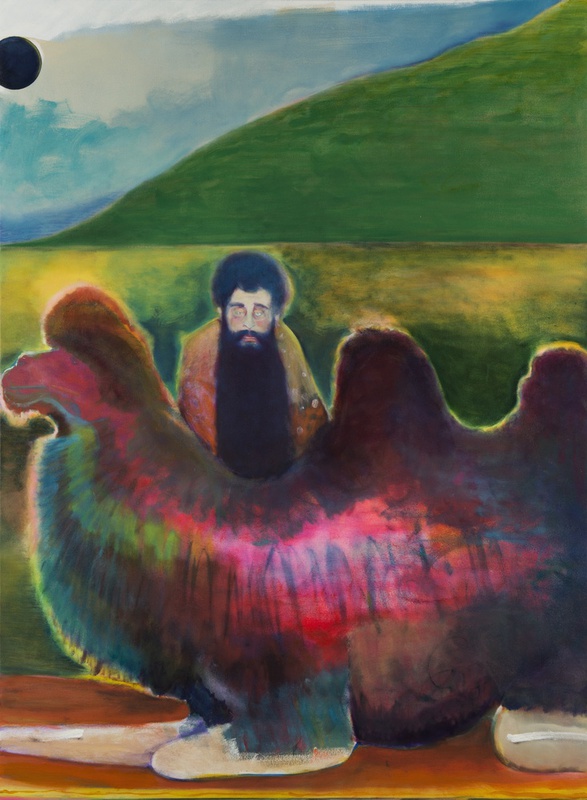
Ryan
Mosley may be the closest Britain has to Neo Rauch's way of painting -
but where Rauch segues pre-communist and more recent elements into
baffling narratives with a faded poster palette, Mosley conjoins the
nineteenth century with ours in surreal situations which tend towards
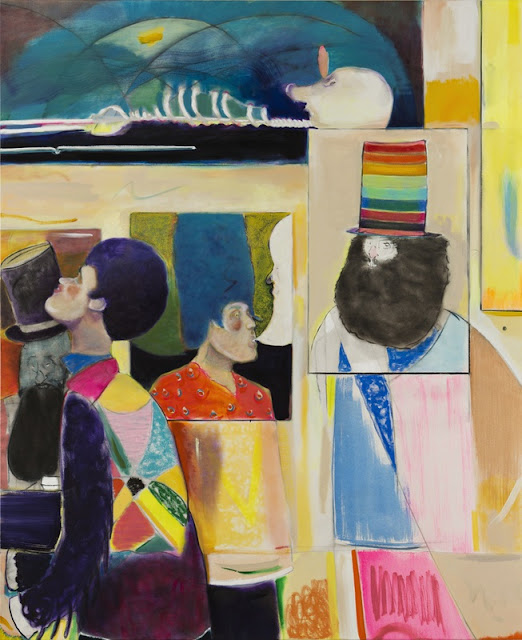
the hallucinogenic. Here a range of character portraits combine with more
complex compositions which feature - by way of my illustrated examples -
the humps of a fluorescent camel rhyming with a beard under a black
sun; and a skeleton atop a cabinet, pipesmoke forming a moon, Afro
hairstyles matching another beard on people most of whom who could be
just pictures, with a bottom right sector resembling passage from
Thomas Scheibitz. The result is too much enjoyment to fuss about
meaning.
 |
Posturing for Conversation, 2016 - Oil on canvas, 183 x 150 cm
|
__________________________
Kate Lyddon: On Drool @ CABIN, 11 Brookwood Road - Southfields
To 12 March: www.cabin-gallery.com
To 12 March: www.cabin-gallery.com
 |
| Installation view |
Kate Lyddon has moved from
making paintings with various materials collaged on to them to installations
which separate the sculpture from the painting. Both elements propose that what
may seem ugly could be beautiful and the conventionally beautiful be left as
ugly – both in how they look and in the materials they use*. At Cabin,
moreover, the paintings (mostly portraits of a sort) are connected to the sculptures
(body parts of a sort) by copper tubes and cutlery: we’re reminded of the tubes
as plumbing inside the body, standing in for the processes of flow and waste, and
the spoons as transporters of sustenance. A circuit is proposed, relating – in
a paradoxically feel-good way – to the biggest contrast of all.
http://www.cabin-gallery.com/kate-lyddon-exhibition-february-march-2016
 |
| VIP2, 2015 |
__________________________
Fiona Banner: Study #13. Every Word Unmade @ David Roberts Art Foundation, Symes Mews - Mornington Cresent
To 5 March: http://davidrobertsartfoundation.com
 |
| Every Word Unmade, 2007: 26 neon parts bent by the artist, paper templates, clamps, wire, and transformers 70 x 100 cm each |
Pretty often
I reckon I’ve seen enough neon, but Fiona Banner – though not greatly associated
with the medium – uses it freshly as part of what proves to be a concise
retrospective in the guise of DRAF’s study programme. Her first, Neon Full Stop (1997), is wittily minimal and maximal at once, a breath encapsulated in glass which prefigures her
move to big, shaped full stops – present here as bean bags. Every Word Unmade
(2007) is a large and stutteringly clunky white neon alphabet ready to
create meaning. It was checked against the paper templates on which
the letters were drawn, causing rather alluring burn marks. Beagle Punctuation
(2011) turns punctuation marks into Snoopy. The Vanity Press (2013) is
an ISBN number published as a book with that reference under Banner’s own imprint.
 |
| Neon Full Stop, 1997 - Neon, wire, transformer, wooden box |
______________________
Marie Jeschke: Can’t Remember Always Always @ l'étrangère, 44a Charlotte Rd - Shoreditch
To 5 March: http://letrangere.net
 |
| 'Kieshofer Moor, Always' |
Berlin-based Marie Jeschke goes against gender stereotypes by using blown-up
versions of collectible football stickers as the most prominent aspect of her
main installation: they are shaped into the form of familial symbols – dating back to
pre-literate times – from Heddensee Island in Northern Germany, still used as
signs on houses. That suggests one form of social identity usurping another, and
Jeschke makes it personal by mounting the images on her grandfather’s images of
the moors nearby, A similar back and forth features in a second room in which she
immerses photographs of childhood scenes she says she’s forgotten in tanks of liquids
from her current life to activate the past through the distortions of the
present.
 |
| ‘Can’t Remember Always Always’, with photos in liquids at front, bottles of liquids at right, processed photos behind |
______________________
Jamie Fitzpatrick: (loudly) chomp, chomp, chomp @
Vitrine, Bermondsey Square & Richard
Ducker: This is the second evening I see 13 rabbits on the grass @
Arthouse 1,
45 Grange Rd – Bermondsey
To 9 April www.vitrinegallery.co.uk / 27 Feb www.arthouse1.co.uk


Perhaps
theatrically
paradoxical sculpture is a trend when two examples open close to each
other on
the same night. From the class of 2015 comes widely-noticed recent
graduate Jamie
Fitzpatrick, with a window (dis)play in which the hierarchies of human
over
horse are a source of conflict, just as the authority traditionally
asserted by
sculptures of great men is undermined by his use of base materials,
shoddily
impermanent aesthetic and cheeky mechanical movement. A sort of mash-up
of Paul
McCarthy and Phyllida Barlow which generates some transgressive clout.
1991 Goldsmiths graduate Richard Ducker constructs a complex account of
what may be his
inner life or just a range of proofs that the self is a construct. You
get
organic sci-fi; homely aliens; turntable-spun modernism;, self-portraits
as a
boy; wall texts channeling spam emails, misery from Facebook and the
creeds of
a manic cult; and a psychic’s reading of
the artist’s three past lives. I‘m not sure it’s worth untangling, as I’m not
sure I’ve untangled it, but it is worth trying to decide whether it’s worth
untangling.

__________________________
Second Edition at the Averard Hotel @ 10 Lancaster Gate - Lancaster Gate
To 28 Feb: www.slateprojects.com
 |
| Ken Sortais: It is In Nature Always That One Should Seek Advice, 2015 |
The dilapidated Art Deco interiors of the Averard Hotel form
a characterful backdrop to a series of six pre-renovation shows organised by
Alex Meurice’s Slate Projects through to October. The current five projects are generally good, evidence
the presence of Damien Meade, Neil Gall, Raphael Zarka, Nika Neelova and Rae
Hicks, solo shows from whom have all been among my previous selections. French
curator Karina El Helou’s ‘A City Without A Song’ makes best use of the
location to build a fictional city of romance past from cast and subverted
elements. She includes Taisuké Mohri’s version of a Greuze portrait with the
illusion of broken glass and the corporeal-tending double-take of Ken Sortais’
latex cast of the iconic Guimard art nouveau entrance décor from a Parisian Métro station (86/141 of which survive
from 1900-12).
 |
| Taisuké Mohri: The Cracked Portrait: Greuze's Boy in a Red Waistcoat, 2015 |
__________________________
Mykola Ridnyi: Under Suspicion @ Edel Assanti, 74a Newman Street - Fitzrovia
To 20 Feb: www.edelassanti.com/ and http://www.mykolaridnyi.com
 |
| From Under suspicion, slide projection of 33 frames, 2015 |
Upstairs at Edel Assanti is like a warzone, but is actually just Jesse Hlebo's dark and noisy curation. Downstairs is quieter and more measured… but we’re in Kharkiv, which really was on the verge of the war on the East of Ukraine, courtesy of one of the nations leading artists, Mykola Ridnyi. In Regular Places the
camera is static, the city calm – but the soundtrack periodically
bursts into the protests and violence which took place six months
earlier. Under Suspicion lays bare the Government’s paranoia through photographs which imitate police archives by applying
literally the instructions in official leaflets about what to take
seriously as a terror threat - ie circling pretty much everything of
interest. But as we know, being paranoid doesn’t mean they’re not out to
get you.
 |
| Still from Regular places, HD video, 15:23 min., 2014-2015 ______________________ |
Marianna Simnett: Valves Collapse @ Seventeen, 270-276 Kingsland Rd –
Haggerston

 |
| Faint with Light, 2016 |
______________________
Frame thy Fearful Symmetry @ Collyer Bristow Gallery, 4 Bedford Row – Holborn & Rachel Mclean at the Zabludowicz Collection, 176 Prince of Wales Road - Chalk Farm
To 24 Feb: (weekdays, by appointment):
www.collyerbristow.com
To 21 Feb: www.zabludowiczcollection.com
To 21 Feb: www.zabludowiczcollection.com
 |
| Rachel Maclean: The Massacre of the Innocents, 2011 |
Curatorial duo Hi Barbara’s choices for the unusual location of lawyers’ offices combine a witty shelf of Richard Wentworth prints with a younger generation of photo-based interdisciplinary artists – Ruth Proctor, Tom Lovelace, David Raymond Conroy, Eva Stenram, Rachel Maclean and Tina Hage – who reframe reality through performance, construction, re-presentation and manipulation. For example, those last two present themselves as the sole actor to contrasting effect; Stenram shows new twists on the questionable but compelling, quaint yet dark voyeurism she extracts from rephotographing and digitally altering sixties glamour shots; artist and ice skating coach Proctor documents her attempts to land the jumps she could nail in her competitive prime, opening up the possibility of failing better – if that’s what falling more often makes for – as she grows older.
 |
| Eva Stenram: Drape (Centrefold II), 2012 |

What's been missing from that long-running show has been a film by Rachel Mclean, but now you can see an excellent presentation of Lolcats, 2013, one of the current choices at the Zabludowicz Collection*. Mclean, as ever, plays all the characters from posh cats to Katy Perry, cyborgs and a gothic surgeon in maximalist makeup for this grotesquely sweet 15 minute tale in which a Tower of Babel tourist park forms the setting for her pussy-girl's journey through linguistic confusion, feline worship and trippy music. It could be a critique of both nationalism and pop culture's constructions of female identity - but mainly it's wow-factor fun.
* part of the group show Use/User/Used/ which is the Collection's annual Testing Ground show curated by MA curating students

__________________
To 13 Feb (Gold) / 9 March (Saatchi)
 |
| Hero, 2015 oil, flashe, lacquer ink on canvas, 152.5 x 320 cm |
You have two chances to see recent work by Julia Wachtel, an
American associated with the ‘Pictures Generation’ who has since the 1980’s
been exploring how our take on images appropriated from popular culture can be
affected by repetition, juxtaposition, changes of scale and clashes of register
– in ways which predated the Internet but now feed off it. Each multi-panel
work combines painted and digital realisations of her sources to further
complicate the status of what we see. To take one example from each show, Landscape No. 19 (Witness), 2014, shows
her typical use of cartoon characters from greeting cards to puncture the
psychology of a scene. Hero, 2015,
suggests that even a superhero – let alone one sourced from a fancy dress
catalogue – is helpless in the face of the global warming represented by a
stranded polar bear.
 |
| Landscape No19 (Witness). 2014 - Oil, flashe and acrylic ink on canvas, 6 panels, overall: 152 x 325 cm |
________________________________
Leipzig Unfolding @ Lloyds Club, 42 Crutched Friars - Tower Hill
To 17 Feb: appointments via email to freitas.lavinia@gmail.com
 |
| Christoph Ruckhäberle: Netsuke 19, 2015 - enamel on canvas, 40 x 60 cm |
A spacious city lunch club provides the unusual location for a 50 work primer of current trends out of Liepzig's Hochshule fur Grafik und Buchkunst, which has a track record for producing painters. The fifteen artists chosen by curator Lavinia Feitas studied with such forbears as Bernhard Hesig, Arno Rink and Neo Rauch. Christoph Ruckhäberle, perhaps the best-known name, shows small scale but high impact enamels of his decoratively posed figures. Rosa Loy, Tilo Baumgartel and Hans Aichinger provide
more of the mysterious cross-historical figuration associated with the
Leipzig School, but there’s plenty else: Henriette Grahnert’s jokes
about abstraction; Claus Georg Stabe’s ethereally obsessive biro drawings; Martin Gross’s intricately gridded woodblock overprintings; Thomas Sommer’s landscape dioramas…
 |
| Rosa Loy: Tuft, 2013 - casein on paper, 40 x 30 cm |
________________________________
Nathaniel Rackowe: The Luminous City @ Lobby One Canada Square - Canary WharfTo 12 Feb: www.canarywharf.com
 |
| The Consequence of Light, 2015, at Canary Wharf |
London is been ablaze with light art. Nathaniel Rackowe features in the centrally Lumiere London, complements the Winter Lights show at Canary Wharf, and also has an external piece near Berkeley Square. Rackowe's work - essentially a re-purposing of urban architectural elements as art and half the way back again – may not be ideally placed in a marbled corporate lobby, but is strong enough to assert itself. There are expanded and collapsed versions of a shed lit from within, a construction to be complemented by dancers, and the kinetic The Consequence of Light, in which the rise and fall of 48 neon tubes makes for a surprisingly epiphanic evocation of sunrise and sunset. Another innovation is the use of dichroic glass, also seen at Hay Hill. It contains no pigment but takes on different hues from different angles due to coverings of ultra-thin metal crystals.
 |
| Portal, 2015, outside the 12 Hay Hill Club |
Rebecca Meanley: When Paint Takes Over
@ Art Works Project Space, 114 Blackhorse Lane – Blackhorse Road tube
To 14 Feb: www.rebeccameanley.com
 |
| Untitled no 1 (dark ground), 2015 - oil on canvas, 146 x 186 cm |
Rebecca Meanley
looks for that moment when she loses control of what may seem a rather well-managed
process of building from a dark ground made from multiple colours – no black
allowed – into brighter hues brushed over wet-on-wet. The tricky bit then, I
suspect, is judging which losses of control are fruitful. She talks of the ‘sheer inability to know beforehand ‘ but seems to get it
right in retrospect in the four big canvases here: the space develops a luminous
depth akin to Sean Scully’s, the thin strokes flicker between Twomblyesque and vegetal,
the scale is right to immerse us in a
forest of speculation. Are we plunging into sombre thoughts or rising to liquid hope?
 |
Rebecca Meanley with Untitled no 4 (dark ground), 2015 - photo, Olivia Bradford
|
To 6 Feb: www.canalprojects.info
 | |
|
James
Brooks’ subtle drawing-originated practice delights in using coded
realities as the basis for apparent abstraction, and the seven
methodological strands of Geometra also link the classical world to
contemporary communications and terrorism. The result is the
simplest-seeming complex show you could wish for. The audio slideshow Stoic Meditations of Marcus Aurelius combines
three elements: seven black and white images of Syrian ruins as they
were before the current conflict; seven selections from the ancient text
chosen for resonance in the context; and a musical score for harp and
flute derived from the sequencing of letters in the quotes. We’re
flickering between chance and calamity, yet the 22 minute whole is
ambiently meditative.
 | ||
|
To
9 Feb: www.theryderprojects.com
 |
| 'Hold', 2015 Painted steel, fluorescent lights, chain-link fence, stainless steel 73 cm x 60 cm |
It’s
a good time to visit the five galleries on the Herald Street block: several
strong shows include such original turns as Kaye Donachie’s face-off of
painting and cyanotype at Maureen Paley and Simon Fujiwara’s shaved fur coats at Laura
Bartlett. Nor is the newest of them outclassed: The Ryder’s garage-with-door
space proves well suited to Mark Davey’s industrial yet corporeal sculptures,
which bring human hesitancy to the mechanical as they trace a neo-romantic path
around the walls: from the hypnotic rise and catch of the pair of
anthropomorphised neon tunes which constitute Us; to the chain-link and light of Hold (for which, Davey says, he chose two of the 400 available colours
of plastic filters) to the poignant dual simplicity of After You Left.
 |
| 'After You Left', 2015 Painted steel and copper 22 cm x 42 cm |
Nika Neelova: Faults Folds Faults @ Vigo, 21 Dering
St – Bond St
To 23 Jan: www.vigogallery.com
 |
untitled (folding chairs) I 2015 Steel, brass, aluminium 90 x 70 x 24 cm |
There
is
no more temporally resonant exploiter of casting then the London-based
Russian sculptor Nika
Neelova. Here she conjures a geology from the
deconstruction and reconfiguration of seemingly casual everyday forms and practices: a
foam version of her studio's gate takes on a lunar surface; the outlines of her studio become
re-positionable steel
drawings in space; chair frames are re-imagined as wall hangings, in brass
which
melds its way to aluminium; copper and brass dust are the muted colours of plaster versions of chair legs; and a floor heap which looks like glass but
proves to be plastic versions of crowd control barriers which can
regulate nothing. Over time, Neelova suggests, ‘the folds have merged
with the object, adopted their forms, discarded their purposes and have become
static, hibernating into their future (non)existence’. I think of them as post-modern fossils.
 |
untitled (folded studio) 2015 - Steel structure based on the perimeter of the studio, folded (welded steel, hinges) 220 x 390 x 140 cm and untitled (gate) 2015 - street dust cast in foam, steel armature (welded steel, cast foam, dust) 200 x 220 x 2.5 cm
|
Mark Fairnington: Collected and Possessed @ Horniman Museum and Gardens, 100 London Road – Forest Hill
To 24 Jan - www.horniman.ac.uk/
 |
| Face Monkey, oil on panel, 10x10cm, 2012 |
The
Horniman Museum, already a fascinating place, is currently enhanced by
an extensive retrospective of Mark Fairnington's photo-realistic yet
uncanny paintings inspired by this and other museum collections: they
include life sized portraits of bulls, close-up tondos of eyes,
panoramic views of specimens in storage, mounted insects trade at human
scale and curious heads from the Wellcome collection. Fairnington has
also delved into the Horniman collection to find on exhibited material
show alongside his paintings., pointing up the constructed nature of the
all that we see here.
 |
| The Ambassadors, oil on canvas, 204x256cm, 2007 (detail) |
________________________________
Derek Mainella: Infinity Poison @ castor Projects, 306 New
Cross Rd – New Cross Gate
To 30 Jan: castorprojects.co.uk
 |
| Untitled (Yellow/Pink), 2015 - oil and acrylic on canvas, 145 x 125 cm - in the dark |
Artist Andy Wicks has set up a project space in a café basement,
and the first show there makes the best of its windowlessness by showing
paintings lit only by the video flames made by a futile attempt to burn MDF furniture,
the ‘infinity poison’ of the title. Canadian Derek Mainella’s attractively
constructed semi-fluorescent abstracts loll out to suggest tongues, faces and trippy pills.
As you join them ranged around the IKEA fire, you can also eat a banana, the artist
having linked the environmental effect of hard-to-dispose-of modern materials to
the genetic vulnerability of the inbred plantain variety on which he recently
lived almost exclusively. Quite a few exhibitions of paintings look better in
the dark: this one’s meant to, but actually I liked the works as exposed by
my flash…
 |
| Untitled (Yellow/Pink), 2015 - oil and acrylic on canvas, 145 x 125 cm - with flash |
. _________________________
Yoan Capote: Isla @ Ben Brown Fine Arts, 17 Brook’s Mews - Mayfair
To 29 Jan: www.benbrownfinearts.com
|
 |
Isla (Ecepticismo), 2015 Oil, nails and fish-hooks on linen panel on plywood, 145 x 168 x 12 cm
|
What
may sound a rather trivial, if impressively obsessive, idea – to attach
fishhooks to twelve seascapes – proves visually effective and
politically resonant. The aesthetic comes from the variety of light and
weathers depicted and how the hooks – 10,000 on a typical picture,
fired black to make them pliable – sculpturalise the sea’s seethings and
create shadows around and within the image. The resonance comes from
how we in the gallery as island look out through the windows of
paintings hung to make the sea’s horizon consistent, and are reminded
that the Caribbean acted as Cuba’s Iron Curtain during the Cold War –
during which Yoan Capote grew up in Havana.
|

_________________________
Rob Pruitt:
Therapy Paintings @ Massimo de Carlo, 55 South Audley St - Mayfair
To 30 Jan: www.massimodecarlo.com
 |
| Installation view |
Rob Pruitt’s last London show was of ‘suicide paintings’. Things
seem seem to be looking up, though, as his latest set finds a generative
process in therapy. Pruitt doodles on a
small pad as a way of freeing himself up during each hour-long session. One
wall holds 36 of these, some of which Shaw has then blown up by computer to
various sizes up to 7 feet high, and overpainted in restrained colours true to the
sketches’ medium of super-standard dark blue biro. Surrealist free association
meets the magnification of small gestures used by such abstract painters as
Kline and Hartung to produce compositions with more life than you might expect. Sculptures of cats accompany the paintings by
way of extra assurance, and it all feels pleasantly odd.


The original 10 x 15cm ballpoint drawing and the 215 x 165cm acrylic, ink oil and water painting for Therapy Painting 8/31/2015
_________________________