Saturday, 15 April 2017

SHOWS NOW CLOSED JAN - APRIL 2017


Sarah Roberts: Torremolinos-Tableaux-Tongue-Twister (After Sun) & Mark Jackson: Face Is The Closest @ Block 336, 336 Brixton Rd – Brixton

To 6 May: www.block336.com 
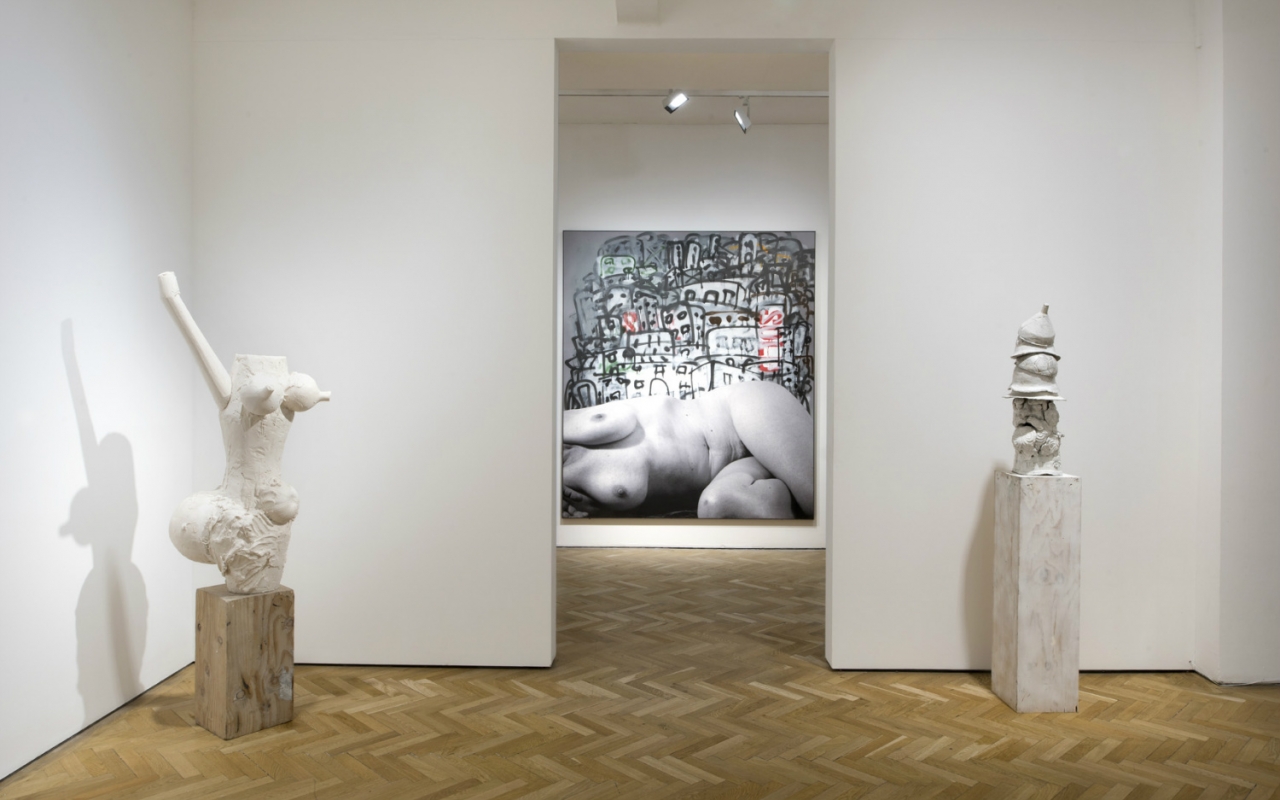
Sarah Roberts installation view

Block 336 has room for two substantial shows, but this impressive pair feels like a whole: Sarah Roberts collects surfaces, here from the capital of crass tourism, Torremolinos, and repurposes them into a cult city unified by redness of object and light in the post-beach sunset in which ‘dark closed in on the pinks… amidst the dried renders crumbling’ *. Mark Jackson’s paintings of barely-present faces evade readability through a marble-smooth screen-like effect built from layers of translucent glazes with a hint of psychedelia. They might be just the right insubstantial inhabitants for Roberts’ paradoxically three dimensional world of surfaces.

Mark Jackson: Surfacing, 2016

* from Roberts’ text
___________________


Spring


Anne Collier, Positive (California), 2016 in 'You Are Looking at Something That Never Occurred'


Spring is bursting forth with photography shows, perhaps on the basis that the Photo London (18-21 May at Somerset House) will see the full blossoming. Wolfgang Tillmans at the Tate, 'You Are Looking at Something That Never Occurred' at the Zabludowicz Collection, the Deutsche Börse prize show at the Photographers Gallery (which has 4/4 worthy winners), 'Double Take' at Skarstedt  and Christopher Williams at David Zwirner are prominent and impressive manifestations, Saatch's selfie show prominent but (though there are good bits) a mess. Roger Ballen at Hamiltons is also worth mentioning, and here are a couple of other less obvious choices from the bouquet:


Scarlett Hooft Graafland: Discovery  @ Flowers Gallery, 21 Cork St - Central

To 29 April:   www.flowersgallery.com


Still Life with Camel, 2016 - 120 x 150cm

Flowers is blooming just now, as the gallery has its best painter at Kingsland Road (David Hepher) and an interesting new-to-Britain photographer at Cork Street. Much-travelled Scarlett Hooft Graafland is one of several photographers to have impressed me in the Netherlands*, and her panoramic landscape images of exotic countries with performative sculpture added  cleverly conjoin beauty, humour, a surrealist streak, art references and cultural import.  Take Still Life with Camel, made in the United Emirates: an absurd take on Christo which subsumes what could have been a biblical scene of camel and riders into a joyous mass of pink.  Or Salt Steps: the Incredible Hulk meets Koonsian inflatables as a Bolivian man’s would-be-power is lampooned by his inability to see where he’s going.


Salt Steps, 2004

* You could make a Dutch school to rival the Finish (currently on view at Purdy Hicks) with women dominant: Marleen Sleeuwits, Awoiska van der Molen, Amie Dicke, Sara Bjarland, Melanie Bonajo, Annegret Kellner, Fleur van Dodewaard and Dana Lixenberg would be my other choices...


___________________


Elger Esser: Morgenland  @ Parasol unit, Wharf Rd - Hoxton 


Salwa Bahry I (detail), Egypt, 2011. C-print, Diasec, 97 x 124 cm

The key to German Elger Esser’s photographs of conflicted territories which appear ‘too quiet’, in the classic Wayne-spoken formulation of the American Western, is his perfect pitch. That brings just the right degree of implication to modest-sounding proposals: ‘fake an archive of views from Israel / Palestine in 1948’;  ‘make big modern photos of Lebanon and the Nile look like fading postcards’; ‘ask another artist to complement your travelogue with paintings of local orchids’ and, best of all, 'show either side of a border view printed on either side of a sculpturally propped sheet of copper’. 

Installation view with 'One Sky' series centre: Photography by Ben Westoby, Courtesy of Parasol unit foundation for contemporary art


Talking of 1948…


                        ___________________


Ella Littwitz: No Vestige of a Beginning, No Prospect of an End @ Copperfield Gallery, 6 Copperfield Street - Southwark


Installation view


Ella Littwitz provides an object lesson in how to generate a political and emotional charge from simple-looking means - all relating to the expansion of Israel into Palestine territory. A filigree bronze cast of Dittrichia Viscosa represents the first plant to colonise disrupted territory, its allopathic qualities enriching the metaphor. Traces of the non-native pine refer to its mass introduction as a sign of support for Zionism: every Israeli receives a tree on birth, and you can have a plaque in the forest named for you if you buy enough extra trees - the imperialist narrative is strong enough for Hezbollah to have attacked trees!  A sort of cellular growth of connected unpicked footballs evokes the story of how UN officials collected and returned balls which children in a school close the border had kicked into a minefield in 1948.


"More poetry than instruction", "More instruction than poetry", chalk on Blackboard, 70 x 70 x 2 cm each

___________________
 
Nathalie Djurberg& amp; Hans Berg @ Lisson Gallery, 27 Bell Street – Edgeware Rd


Still from Worship, 2016

Nathalie Djerberg and her musical mood-darkening collaborator Hans Berg have tended to prefer experiment to formula in recent years, with patchy results. But here they return to what they’re known for, with three short and transgressive claymation films. If you want a goat suckling a tiger, an aubergine car and frankfurter motorbike, turds growing up lively, a moon which moons (buttocks added for the purpose), a doughnut drinking tea, love made to a banana and a well-hung matador applying his best estocada to sponge cake, then these short films are for you.  It’s hard not be jealous of such a playfully perverse subconscious.
Still from Delights of an Undirected Mind, 2016


                                              ___________________


Maria Lassnig: A Painting Survey 1950-2007 @ Hauser & Wirth, Savile Row - Central

To 29 April: www.hauserwirth.com


Self-portrait with speech bubble, 2006 - Oil on canvas,  200 x 150 cm 

Following her shows at the Serpentine (2008) and Tate Liverpool (2016), it’s not exactly a secret that Maria Lassnig (1919-2014) was one of the best painters of the last 50 years, but this estate-driven show reinforces the point with examples not previously seen in Britain. It clarifies her geographically-driven phases rather well: from early Viennese experiments in hard-edged abstraction to more expressionist abstracts leading up to her move to Paris in 1961, where she developed her ‘body-aware’ style of figuration. Relatively realistic works followed as she found herself a painter reacting against the prevalent conceptual use of media in New York (1968-80). She returned to Vienna in 1980 to become, at 60, the nation’s first female professor of art. Self-portrait with Speech Bubble is typical of Lassnig's late, great flowering, showing her concern with the directly sensing parts of the body – no need, it seems here, for a brain.


Girl with Wine Glass, 1971 - oil on canvas, 178 x 127cm
                    

                        ___________________


Richard Mosse: Incoming @ Curve Gallery, The Barbican 


Still from Incoming, 2016


Richard Mosse made a big splash at the 2013 Venice Biennale with his film of the ongoing war in the Congo. He shot it with discontinued reconnaissance infrared film which turned much of the battle scenery pink, so infecting the scenes with a surprising look which also carried political resonance. Can he replicate that kind of impact? It seems so: The Curve features film footage centering on refugees movements and still images of the associated camp infrastructure. Both are taken with a thermal camera which can distinguish people at a distance of 30 km and, as such, is classified as a weapon for export purposes. Again, the aesthetic is beautiful and distinct. Seeing thermally removes racial differences but emphasises mortality. Even though Mosse doesn’t really exploit the unusual dimensions of the Curve, his name can be added to the list of artists who – out of 27 high quality commissions - have excelled there over the last decade: Richard Wilson, Clemens von Wedermeyer, Robert Kusmirowski, Celeste Boursier-Mougenout, Song Dong and Random International.


Hellinikon Olympic Arena, 2016, digital c-print on metallic paper

                          __________________

 Architecture as Metaphor @ Griffin Gallery, 21 Evesham St - Latimer Rd


Evy Jokhova: Installation view of Puddle, 2011 - film with mirror


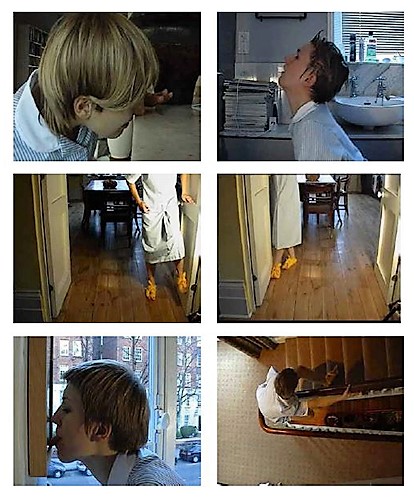
There are several good reasons to visit the Griffin Gallery. Free coffee; the sculpture, paintings and drawings exploring ‘architecture as metaphor’ have been chosen astutely; Phyllida Barlow, just ahead of her Venice appearance, links a typical sculptural pile to a spot-on stream of consciousness about getting lost in The Barbican (we’ve all been there if we’ve been there); Peter Newell Price pulls off the improbable project of making a rose window out of graphite. Yet the main reason for attendance could well be the film works by Gary Stevens, Evy Jokhova, Jemima Burrill and Lucy Gunning.

Jemima Burrill: stills from Cleaner, 2004


___________________ 

Love Peace and Happiness: Kiera Bennett, George Little, Phil Root, Anthony Banks, Nicholas Johnson, Gwennan Thomas, Nick Jensen, Fiona Curran and Jackson Sprague
@ Menier Gallery, 51 Southwark Street - London Bridge

To 22 April: https://www.kristianday.co.uk/love-peace-and-happiness /  
http://meniergallery.co.uk
Fiona Curran relaxes in her installation Pale Horizon, 2013
The cavernous Menier gallery -  a good charitable cause ('Paintings in Hospitals') but also a space for hire with dodgy shows likely to result - has shifted its model by inviting Kristian Day to bring together a nap hand of nine painters who all bring a savvy joi de vivre to a dialogue between decorative embellishment and serious intent. Among many pleasures is a cheeky hang which gets away with installing groups of separate works on top of each other. Fiona Curran, who shows a new stream of single works made with combined canvases, emerges as the widest ranging: she also wrote the press release, and her enticing installation is the main sculptural work. That contains ostrich feathers, encouraging us to notice that what we read as clouds in her paintings are actually the bodies of ostriches, in a neat reversal of our established tendency to see animals in clouds.
Fiona Curran: Body of an Ostrich, 2017 (diptych, 91 x 93cm


  ___________________


Aleksander Hardashnakov: You Turn On Me @ Union Pacific. 17 Goulston Street – Aldgate


Installation view with 'Find Your Own!', 'Pregnant Barbie', Stalker' and 'Painting for Liliana'


Toronto artist Aleksander Hardashnakov is an arch avoider of the signature style, but there’s a dark humour to quite a few of the 21 canvases which ring Union Pacific’s space cheek by jowl. He says ‘everything is inspiring’, and they channel all sorts of templates from Georgia O’Keefe to Kasimir Malevich. Hands meace, Barbie is pregnant, keychains cause stress… The circle of works is reflected in a charity collection style sculptural contraption in which coins run around hypnotically before disappearing down its black hole… to land on the floor. So much for the show’s economics, you can retrieve your money. Hardashnakov would like to make this as a public sculpture open to vortex-addicted skateboarders. I’d like to see that: the next 4th plinth vacancy is in 2022…


Black hole, tip jar, wishing well (proposal for public sculpture), 2017


  ___________________

 
Rhys Coren: Whistle Bump Super Strut, 270-276 Kingsland Rd - Haggerston


A slow (intro), 2017 - spray paint, acrylic and pencil on board


‘Two painting shows in a row!?’, I teased Dave Hoyland, ‘Are you selling out?’ ‘Luckily’, he says, ‘yes’ – which must be welcome after Seventeen’s ill-fated New York venture. And it’s easy to see why Rhys Coren’s funky abstractions, originally scheduled for the US, are popular. But there’s quite a lot to them, too: they’re not straight paintings but combinations of laser-cut wood like intricate puzzles; the colours are muted yet lively in combination; they’re replete with complicating effects like blurred areas, drop shadows and surfaces treated to resemble patio paving; each has a snappy title and these are joined up to turn the press release into a poem... Dance the dance, dancing feet / Red-faced with embarrassment / Cheeky, cheeky. Naughty, sneaky / Shame on you (if you can’t dance, too)...


All My Beautiful Evil is Melting, 2017 - spray paint, acrylic and pencil on board


  ___________________


Gordon Cheung: Unknown Knowns @ Edel Assanti, 74a Newman Street - Fitzrovia

Turkey Carpet (after Francesco Fieravino,1650-1680 ), 2017, giclée on canvas, 128 x 136cm
Gordon Cheung is known for apocalyptically coloured paintings which play against the collaged backdrop of stock listings as a charged way of exploring capitalism and its cyclic discontents. These, have become increasingly baroque, as in the tulips in which pre-sculpted paint forms fully modelled petals. Now two new series play off that practice. Grand panoramas use sand to irritate the surface as they subvert Chinese painting traditions by showing 21st century realities. And digital prints on canvas run with the computerisation of stock listings and the distortions of the market, by allowing a programme glitch to disrupt the data files of their image sources to bewitching effect. These, even when you know they’re the only flat works in the show, often look remarkably textured.


A Thousand Plateaus, 2016 -  financial newspaper, inkjet, acrylic and sand on linen, 200 x 450cm triptych
_____________
Saad Qureshi: time | memory | landscape @ Gazelli Art House, 39 Dover St - Central

To 16 April: http://gazelliarthouse.com

Beyond Mental Boundaries, 2016-17 - brick dust, charcoal, ink, 160 x 210cm
As the show title spells out, perhaps a little too didactically,  Saad Qureshi’s two new streams of work combine time, memory and landscape. The results might be called mindscapes: big vistas made with charcoal applied to the sumptuous surface of brick dust create memories of nature in the classic material of the manmade; and smaller views burnt into paper with a soldering iron suggest how places may be seared into the memory. Both those resonant uses of material took effort: it wasn’t a simple matter for Qureshi to find a supplier willing to crush their bricks to powder for him; and the six works on paper are the survivors from 37, most of which caught a little too much fire!

Scorched lines - S1, 2016 - burnt paper, 57 x 70cm
   ___________________


Kazuo Shiraga @ LĂ©vy Gorvy, 22 Old Bond St - Central


Chikisei Sesuisho,  1960  -  Oil on canvas, 130 x 193 cm

I take little notice of the market, but it’s hard not to be aware that the price of a good Shiraga has increased tenfold in the ten years since the leading GutaĂŻ member (1924-2008) last showed solo in London. And these are good examples, especially the three from the ‘Margin series’, named for outlaw characters in the Chinese saga of bandits revelling against the emperor – just as Shiraga rebelled against convention by sliding across and swirling around the paint (actually applied by his wife) into place with his feet as he swung across the canvas. What started as a provocative action in 1954 generated a stream of supra-residual results combining violence, dance and meditation. Shiraga went on producing them until his death, undeflected by being a Buddhist priest from 1971.

Mid-fifties action....
__________________________


Sebastian Stöhrer @ Carl Freedman Gallery, 29 Charlotte Road - Shoreditch

To 11 March: http://carlfreedman.com


Frankfurt-based Sebastian Stöhrer sets up a striking array of anthropomorphic ceramics which yet retain some vestigial potential for functionality. Maybe it’s a forest of forms, as Stöhrer includes wooden legs and even a collar of fungus on one of his folkloric figures. Up close, the alchemical glaze colours and witty inventions of form make this an engaging contribution to the recent resurgence of clay in art.Here's a would-be-jug with tongue and balls:


_________________________


Rebecca Meanley: ‘The inexplicable moments of painting’ @ Cadogan Contemporary, 87 Old Brompton Rd – South Kensington

To 4 March: www.cadogancontemporary.com


Untitled (ochre-magenta), 2016 - oil on canvas, 145cm x 145cm

It’s an old twist: ‘actually that’s not an abstract painting’, you say, ‘but a highly realistic  representation of an abstract painting’. Just so, in a way, Rebecca Meanley’s 16-strong 2016 set of 1.45m square canvasses all start by depicting the rag she used to wipe away paint from the last one in the cycle, and then diverge into the wet-into-wet realm of intuitive colour and gesture. ‘Oh but they are beautiful!’ you will say, which is hard to deny, but it’s the intensity of exploration which gives them the backbone without which beauty can be mush.


The artist in and largely with Caribbean Blue, I reckon

__________________________


Mark Woods: ‘A Return to Old Certainties’ and Lee Maelzer: ‘Losing Up For Made Time’ @ Lubomirov / Angus-Hughes, 26 Lower Clapton Rd – Hackney


A glimpse into Mark Woods' installation

Here’s a fine contrasting double show. Upstairs Mark Woods makes a spectacular presentation of a decade’s production of glamorously kitted out sculpture-jewel-toys serried in the drawers of superbly carpentered cabinets and reflected in the spinning mirrors of an impressive peephole kaleidoscope installation. Woods’ objects transcend function, but would fit in with sex being sold as a religion: the old certainties of commerce, desire and god are artificialised, and in the middle sits a gleaming black heart. The hemmed-in basement space, dark at the building’s heart, also holds many works, but these are a tributary of Lee Maelzer’s practice: intensely atmospheric small photographs and collages, often with painted interventions, which feed into her paintings – which are often of dimly lit interiors. 


Lee Maelzer: Birthday Cake, 2013, altered photograph,
19 x 15 cm
 __________________


Luiz Zerbini @ Stephen Friedman Gallery, 25-28 Old Burlington St – Central


Cabec? a d'Agua, 2016, Acrylic on linen, 240 x 240cm


It’s a measure of how tough it is for artists that few from Max Wigram's roster have been picked up by other London galleries  – as Luiz Zerbiini  has - since Max Wigram’s precipitate closure in 2015.  The Brazilian  works across abstraction and representation separately but simultaneously, and it’s obvious how the streams of painting influence each other: the patterns of Rio’s  reality are exaggerated, the abstracts suggested perceptual hazing of the world. A similar to and fro operates in his unusual and historically resonant collages of found slides. Plus, in a new development, Zerbini has started to apply obsessive pencil workings to some canvases, and the low key  pseudo-metallic look of that has also started to spread into his whole practice.


Quadrado Novo, 2016, Acrylic on canvas, 220 x 160cm
__________________________


Adam Hennessey: Smile @ New Art Projects, 6D Sheep Lane - Cambridge Heath


Sheep Murder, 2016 - 155 x 110cm

Young painter Adam Hennessey describes his work as ‘squishing large things into small spaces’. That’s true of many of the wittily ebullient acrylics on show here – several smiley faces jostle to be sunniest, and birds struggle to fit in their framing. But there’s no squishing required to get these 25 canvases into Fred Mann's expansive new space. Indeed, there’s enough capacity to hold a room back for small works on paper to be painted ready for a closing event on 4 March. Hennessey has a particular affinity with fingers and sheep: the former appear directly several times , though the ‘Finger Alphabet’ merely points to an anagram caused by alphabetical order; a characterfully distinguished herd of the latter seem to have been shot – if only, perhaps, with paint –  before they can enjoy the lushest grass you ever didn’t really see, it was just a picture in Sheep Lane.


Alphabet Finger, 2016 x 110cm


                                                                                  ____________________________________


 Three shows curated by me...  Ears for the Eyes (to 4 March at Transition Gallery) / Show Us Your Process / The Other Side (both to July at House of St Barnabas - contact art@hosb.org.uk to visit)

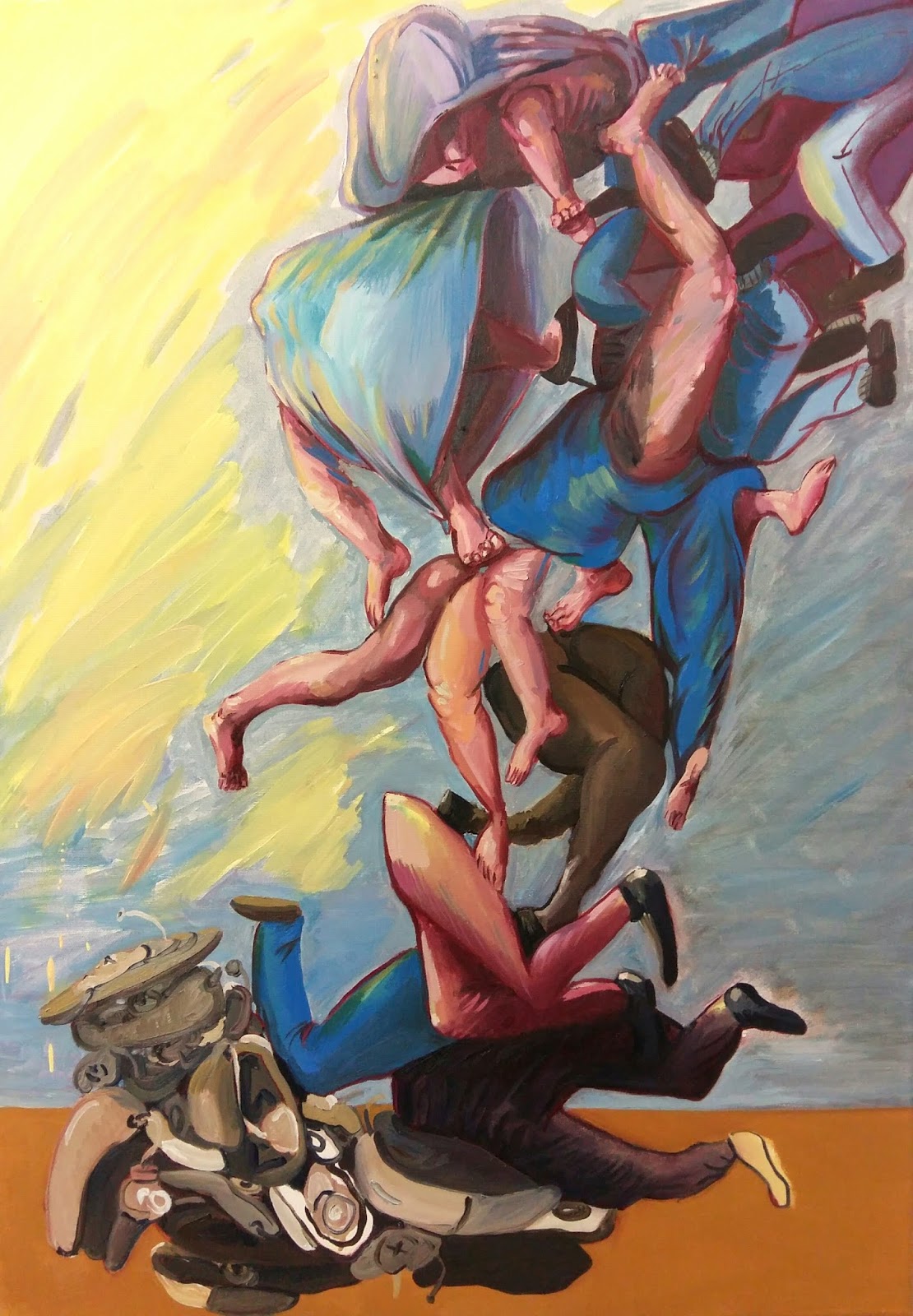
Emma Cousin: Falling on Deaf Ears

Separate entries might be a little excessive, but naturally I believe that 23 of the best artists currently on show in London are in three shows I’ve curated: ten plus accompanying magazine in the eccentric Ears for the Eyes at Transition see http://paulsartworld.blogspot.co.uk/2017/01/ears-for-eye.html; thirteen across two shows at House of St Barnabas: abstract painters showing how various distinctive processes enable them to play off chance and control to aesthetically transcendent effect(http://paulsartworld.blogspot.co.uk/2016/12/show-us-your-process-preview.html) ; and my four favourite young figurative painters, creating a room full of character and presence (http://paulsartworld.blogspot.co.uk/2016/12/the-other-side.html). 


Adam Dix: The Collectors


Installation detail: Sarah Pichkostner


Florian Roithmayr: ir re par sur @ Bloomberg Space, 50 Finsbury Square - Moorgate (to 18 March: https://www.bloombergspace.com)

Sarah Pichkostner: Kay calls me all the time in other words fly me to the moon @ Josh Lilley, 44 – 46 Riding House Street - Fitzrovia (joshlilleygallery.com)
Good sculpture often emerges from letting the material have its way, giving the – somewhat misleading – impression that the artist didn’t have to do much. London-based German Florian Roithmayr plays airily located, elongated U-shaped hangings (cast in plaster from card originals) against more bodily forms. Roithmayr spread clay on paper on the Bloomberg floor, waited six weeks for it to dry and, as the shrinking caused by the 30% which is water evaporated, curl up. Then he raised up his appealingly casual population of forms... Austrian sculptor Sarah Pichkostner’s first London solo show is a subtle grower. The title comes from an audio piece smuggled into a foam sculpture which whispers urgently yet tantalisingy close to inaudibly. A little like Roithmayr, she lets silver nitrate act from inside to ensilver glass tubes, and also coaxes coloured light into doing its stuff variously: in the sculptures, shone on the sculptures, glowing from behind a wall – and is used to yellow a narrow back-of-wall space at Josh Lilley, which she uses better than anyone since Analia Saban in 2009. Is this, perhaps, what sculpture would be like on the moon?


Installation detail: Florian Roithmayr 

___________________________


Irina Korina: Destined to be Happy @ GRAD, 3-4a Little Portland Street – Fitzrovia

To 28 Feb: www.grad-london.com


Russian artist Irina Korina, who trained as a set designer, is known for her theatrical installations made out of commonplace materials. Here she presents whimsical soft sculptures of black and white emoticon characters - a human meteorite, a fire-person, a teardrop smoking a cigarette. They’re set in a hostile forest environment which didn’t prove so easy to source as one might expect. When the show was put up in early December, dead Christmas trees were so rare that she had to have twenty healthy specimens torched. Now, it fits the calendar: too much drunk over the festive season, you come round and it's Trump.  So if blasted joy is your thing, you’ll like the heavily ironic ‘Destined to be Happy’ - the more so as each of the six sculptural stations comes with its own atmospheric soundtrack generated out of aural bric-a-brac by Sergey Kasich.


                                                                            ____________________________________


Mudhook @ Tintype - 107 Essex Road - Islington plus three shows curated by me at Union and the House of St Barnabas...

To 18 Feb (Tintype and Union) / 5 July (House of St Barnabas)

Emma Cousin: Inpatient, 2016 - 120 x 100cm
 Separate entries might be a little excessive, but naturally I believe that 14 of the best artists currently on show in London are in three shows I’ve curated:  a wider view of Alice Anderson than her well-known copper wire bindings (see  http://paulsartworld.blogspot.co.uk/2016/11/alice-anderson-post-digital-11-nov-2016_4.html   for details); nine abstract painters showing how various distinctive processes enable them to play off chance and control to aesthetically transcendent effect(http://paulsartworld.blogspot.co.uk/2016/12/show-us-your-process-preview.html) ; and my four favourite young figurative painters, creating a room full of character and presence (http://paulsartworld.blogspot.co.uk/2016/12/the-other-side.html).  What’s more, Emma Cousin, one of the four, also features in a lively two-hander at Tintype. She’s paired with Milly Peck, whose scribble-like sculptural versions of everyday forms enter into a lively to-and-from with Cousin’s leg play.
 
Alice Anderson: Cut Out Pieces from Repetitive Gestures,2016

 _                                                                                           ____________________________________


 Room and Condo (Bridget Donahue) @ Sadie Coles, 62 Kingly St - Oxford Circus

To 18 February - www.sadiecoles.com


    Heidi Bucher: Herrenzimmer (1977-79)


The admirable ‘Condo’ initiative, in its second year, sees 36 foreign galleries guesting in 15 London spaces, to generally lively effect. Some mix things up between host and guests, but my two favourites - Sadie Coles and Rodeo – are among those which juxtapose a separate host show with a guest solo. AT the former, Bridget Donahue presents Martine Syms, which is interesting, but the prime draw remains the outstanding group show Room, which brings together a wonderful combination of female artists reimagining domestic space. For example photographic work by Francesca Woodman, Nan Goldin, Joanna Piotrowska and Penny Slinger, and several room reconstructions in the gallery, including a smoking shed by Sarah Lucas; Heidi Bucher’s latex imprints of the walls of her father’s study; and a black room full of Klara LidĂ©n’s teenage angst, the door into which is made harder to open by a hanging axe.


Penny Slinger: 
No Return (An Exorcism), 1977 Collage 33 x 48cm
_____________________________________

Marcus Harvey:   Gimme Shelter @ Vigo,  21 Dering Street - Bond Street


To 18 Feb: www.vigogallery.com


The English Cemetery, 2016 and Untitled (Big Galleon), 2016

Marcus Harvey, though he identifies as a painter and is a leading light in the Turps Banana school (Adam Hennessey is one recent student) mixes it up with lots of sculpture, and his paintings are often predominantly photographic or have sculptures appended. This potted version of his recent retrospective at the Jerwood in Hastings – where his nautical themes met the sea – feels timely: his jarring combinations satirise Britain as stuck in ramshackle post-colonial mode, which is one view of our withdrawal from the EU.  By jingo, we used to rule the waves! Hence, perhaps, the cast assemblage which makes up a naked Maggie of the Falklands, the white cliffs of Dover looming with the immersive scale of a Clyfford Still, and the use of cast tropical fruits to form a parody of female fructitude…

Big Girl, 2015, Gimme Shelter, 2016 and War Head, 2016
______________________ 


I Lost My Heart to a Starship Trooper @ the Griffin Gallery, 21 Evesham St – Latimer Road *


To 24 Feb: www.griffingallery.co.uk


Stephane Graff: Untitled (Courbet / Fontana), 2015

Catherine Loewe’s exhibition is easy to enjoy: she picks nine artists who have appropriated the art of the past, and lets us explore their different methods and aims.  Diptychs by Stephane Graff wittily line up iconic works with mismatched texts from what seem to be auction catalogues, pricking the bubble of artistic identity which Gavin Turk undermines by taking on that of others, here through his British styling of Warhol as the silkscreener of white transit van crashes (there’s more of that at the Newport Street Gallery) ; Marielle Neudecker and Gordon Cheung both deconstruct the Vanitas still life in painterly non-paintings, the former as plastic, the latter as digital glitches; and Glenn Brown seems to reveal the atomic under-life of old masters in his re-imaginings on the cusp of painting and drawing. 

* worth being away also interesting shows in the Griffin's rear windows and at nearby Unit 1 Gallery


Glenn Brown: Hinckley Point, 2016 - Indian ink and acrylic on panel, diptych - Each 60 x 50 cm

_____________________________________

Thinking Tantra @ Drawing Room, 8 Rich Estate, 46 Willow Walk – Bermondsey


Installation view with Jean-Luc Moulène (front), Nicola Durvasula, Alexander Gorlizki and Shezad Dawood (back left to right)


This fascinating show starts from anonymous drawings created not as art, but as a technique for expanding knowledge. It moves on to ‘neo-tantric' works which go somewhere else from the tradition, then on to non-tantric artists who admire and are influenced by the tantric works when making abstractions without the same purpose.. Highlights include Alexander Gorlizki’s collaborative work with Indian miniaturists; Tom Chamberlain’s nearly-disappeared / not-quite-here-yet shapes; a painting on vintage textile by Shezad Dawood; Prem Sahib's sexualising of the putative genre; and Richard Tuttle’s perfect match to the spirit of the show. All this exudes inner calm, speaking of which…


Richard Tuttle: Separation (Group 3, Numbers 2, 3 and 4), 2015

  ______________________

Minjung Kim: Phasing @ Patrick Heide, 11 Church Street - Marylebone


Red Mountain (14-059), 2014 - Watercolor on mulberry Hanji paper, 12.5 x 28 cm

If it's 'always the quiet ones', then Korean Minjung Kim is a the least noisy of pyromaniacs. She's best known for her beautiful collages of red or black ink-washed rice paper which she delicately singes to make irregular edges, then overlays to form mountains. These are complemented at Patrick Heide by new streams of work, most strikingly the musical parallels of her 'Phase' series, in which a front sheet in which holes are burned through is set on top of an inked back sheet to form near-repeated forms, and the rhythm of the whole is a function of the extent of repetition and the subtlety of the variations. You have to look very closely to understand - or believe - how these are made. Korean abstraction is very much in fashion*, and though Minjung isn't 'Dansaekhwa', she should be part of the efflorescence. 
Phasing (16-069), 2016 -  Mixed media on mulberry Hanji paper, 74.5 x 65 cm

* See eg Park Seo-bo at White Cube now, or recent London solos of Yun Hyong-keun (Simon Lee), Lee Ufan (Pace) and Cho Yong-Ik (Oliver Malingue)


__________________________

Elpida Hadzi-Vasileva: An Intimate Gaze @ Danielle Arnaud, 123 Kennington Rd – Kennington


Elpida Hadzi-Vasileva  Gill’s Slits  2011 - skate bones, metal, perspex box  45 x 45 x 50 cm


Paul Nash: Flight of the Magnolia, 1944 (from Tate Britain show to 5 March)


It’s an old gambit to generate beauty from abject or repulsive material. All the same, Anglo-Macedonian artist Elpida Hadzi-Vasileva’s use of animal materials is striking: she’s best known for immersively delicate installations using waste products from the meat industry. Here, a domestic environment suits a transcendental drawing made from a cow’s guts, bovine intestines blown up to form vulnerable sculptures,  and four sheep testicles configured as rather attractive purses. The most radical form, though, is probably Gill’s Slits, made by simply alligator-clipping together the wing-like skeletons of several skates. This inside-to-outside move yields flyaway fish with a floral feel. I was somewhat reminded of Paul Nash’s 'Flight of the Magnolia' 1944, which you can see in the excellent survey at Tate Britain.
 
Elpida Hadzi-Vasileva Lady's Purse,  2011 - sheep testicle purse lined with silk, antique frame and chain, mounted in perspex box

__________________________


Franziska Lantz: expanding arid zones & Haris Epaminonda: Vol. XX @ RODEO, 123 Charing Cross Road – Tottenham Court Road 


Franziska Lantz: detail of  expanding arid zones 

Rodeo’s Condo share presents two installations representing found elements to transformative effect. Downstairs we can move on from the injustice of Michael Dean not winning the Turner Prize to admire an installation by his Swiss-German wife Franziska Lantz. Both are represented in Berlin by Supportico Lopez: here Lantz has trawled the Thames for detritus which she cleans with contemplative obsession, then hangs to form a shamanistic whole room installation featuring a surprisingly high proportion of camouflage wear. It’s complemented by her soundtrack – cluing us in to a wider practice which includes a regular broadcasts for Resonance FM. Upstairs are what might be termed ‘overlages’, by Berlin-based Cypriot Haris Epaminonda – collages in which the top layer (black and white images of ikebana flower arrangements) almost completely covers the lower layer (would-be-colour of Egyptian art). It’s mainly the captions, referring to pharaohs, which remain to complicate our interpretation of the bouquets. 

                                 _____________________________________


Tuesday, 28 March 2017

THE OTHER SIDE OF THE PROCESS


THE OTHER SIDE OF THE PROCESS
On 24 March a the House of St Barnabas, seven of the artists in ‘Show Us Your Process’ and ‘The Other Side’ spoke for five minutes each on a variety of topics related to the work in the shows Here’s a summary of their contributions on what proved a fascinating evening. See
and  
for full details of the artists' works.
Tony Charles - Industrial Steel Benches
Tony recalled how – as soon as he went into the steel industry in Middlesbrough, where he now runs Platform A gallery – he realised he had sooner he’d gone to art college. He worked in the industry for 13 years, and was always fascinated by the marks which were the contingent result of the industrial processes which were carried out on steel benches, such as clamping steel sheets in place with a dog, and dressing them with angle grinder. In his early years, he would take whatever opportunities he could to look down on these benches from above in order to get an overview of the pattern of marks, despite his supervisors suggesting that there was work to be done! Now, those same processes feed directly into how he makes his art.
Tom Hackney - Duchamp's Chess Career

Marcel Duchamp: Pocket Chess Set, 1943

Tom has to date made 96 paintings which plot the action of the moves in recorded games by Marcel Duchamp. He was a serious player when he prioritised chess over art: among the top 25 amateurs in the US, representing France in four Olympiads. His play was solid, at times brilliant, but showed a tendency for endgame errors. Tom drew attention to the way in which chess strategy had evolved in the 1920’s with ‘hypermodern’ play, which eschewed the classical approach of occupying the central squares, instead pressurising them from peripheral positions. A parallel strategy operates in Duchamp’s art, which itself often featured chess in line with his interest in the game: as in the family scene The Chess Game, 1910, and Portrait of Chess Players, 1911, the cubistic precursor to the conceptual motion of Nude Descending a Staircase, 1912.

Marcel Duchamp: Portrait of Chess Players, 1912
Neil Zakiewicz - How Much Control Is Too Much?
Neil pondered the question ‘how much control is too much?’ in the context of his practice, in which he has often delegated the image production to a car spray paint workshop. In fact, he said, he is keen to maintain as much control as possible, and in that case his instructions were very precise even though he liked the thought that the car workshop staff were disinterested in the aesthetic outcome. Moreover, in his most recent series, which involves graduated spraying, he found it too difficult to give the precision of instruction he felt necessary, and has done the spray painting himself. All the same, he finds and happily accepts that it is the boundaries of the process still beyond his control which are often most fruitful: at the House of St Barnabas, the effects of the wall colour, the cord hanging system, and the shadows.
Emma Cousin - Standing Your Ground
 
Since starting to explore legs in her paintings, said Emma, she’s revelled in the puns of our physical agency and the formal concerns of making a painting. Thus ‘we stand on the ground, are grounded in history, and paint on a ground’. She imagined all the things that might happen in the Silk Room: dancing, meeting, talking, eating… and made paintings which reflect the room’s elements, using the patterned textures of the walls as a stand-in for the skin that's missing in her cartoonishly painted legs – legs which become a meal in Dinner Table; fit like a puzzle round the mirrored floor patterns of Cutting a Rug; or get painted from the viewpoint of the table at the middle of Bees Knees. That empty centre is the white primer of the painting’s ground. It things not said, not painted. But also the pond of potential paintings, of possible next moves. The ground of absence proves pivotal to how Emma and her work stand their ground.

Michael Stubbs - My Favourite Painters

Paolo Veronese: The Family of Darius before Alexander, 1565-7

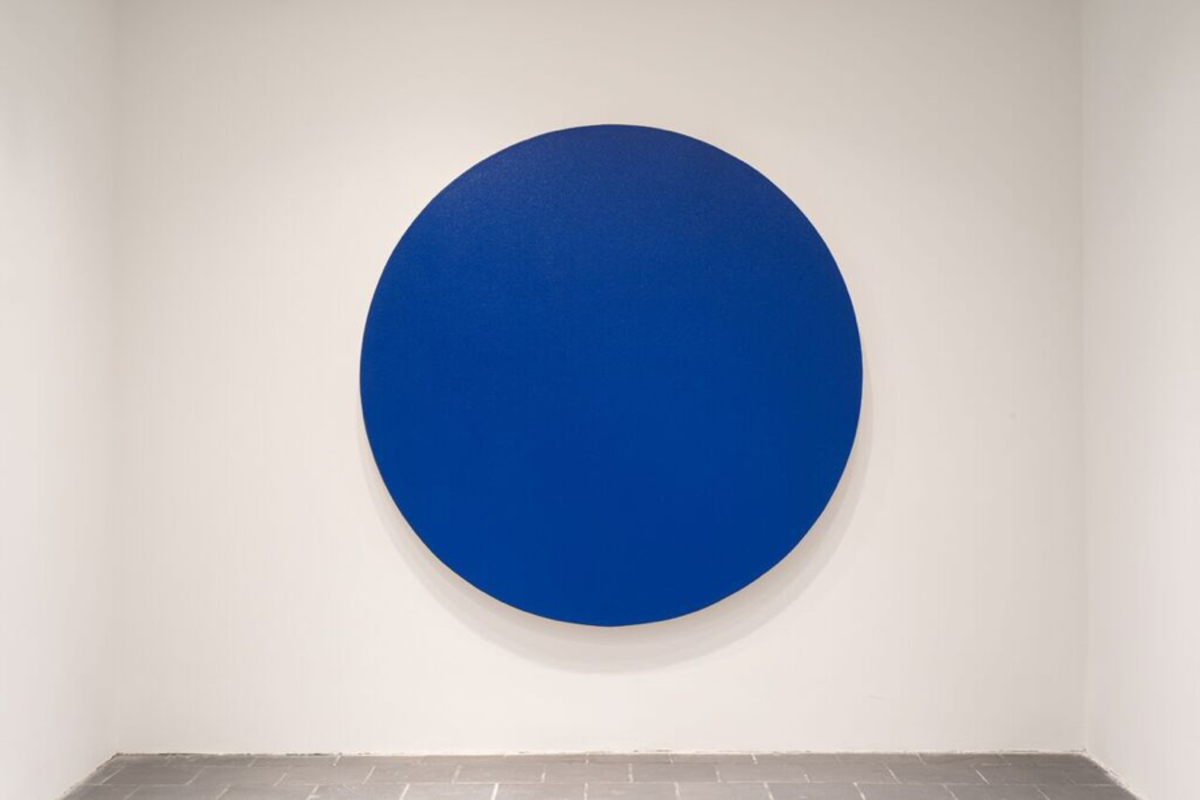
Michael talked about the inspiration he has gained from Paolo Veronese (as exemplified by the National Gallery’s The Family of Darius before Alexander, 1565-7, and from the tondi of the contemporary Swiss painter Olivier Mosset (born 1944). The former is his favourite painter from the period during which perspective with a central vanishing point became the accepted language. The latter is a monochrome abstractionist who makes his work in ironic response to Clement Greenberg’s requirement that paintings should emphasise their nature as paint on a flat surface. Such a contrast in perspectives ties into Michael’s aim of setting up collisions of different traditions which arrive at a third place: colour field abstraction (Morris Louis in particular) meets graphic pop (aspects of Warhol) in his own work, but there is also a combination of layered depth with a non-perspectival lack of it. That suggests advertising and screens – and also brings together the not-so-obviously compatible Veronese and Mosset.

Olivier Mosset :  O2, 2015  

Shane Bradford - Painting and Geology


In what could have been a motto for the ‘Show Us Your Process’ room, Shane said that he saw painting as a matter of embodiment, not representation. His work in the show embodies decidedly geological processes. First, because he repeatedly dips his canvases in tanks of paint, building up layers of colour and stalactite formations along their edges. Second, because in the series from which Blueschist is taken, he also dips old clothes from friends and family into paint and presses them against the surface, so adding the strata of the personal histories of the clothing as worn – here pants, vest, T-shirt and bra. Third, because the resulting black and white patterning looks somewhat like marble. Life, he concluded with the flourish of removing his hat to reveal a freshly-shaved head – is, like geology, essentially about change, as illustrated to those in the audience who remembered his hair!
Martine Poppe - The Politics in My Work
Martine talked quite emotionally about how she had been unable to represent the issues she felt strongly about post-Brexit, and was driven into abstraction. Travelling widely in America just prior to Trump’s election, she had then been struck by the extent of the difficulties suffered by the underclass in the US, by the segregation of populations by colour still being the norm in the south, and by the police assumption that as a young white woman she needed protection in black-populated areas - in which she’d actually encountered nothing but friendliness. None of that had felt paintable to her either, but when she talked to and photographed young voters ahead of the poll, she saw a way to represent events– leading to her use of an image silkscreened in printer’s ink. Blue and Brown are half printed, half painted; half representational, half abstract.


SHOW US YOUR PROCESS

SHOW US YOUR PROCESS

Curated by Paul Carey-Kent

Bazalgette Room, the House of St Barnabas, 1 Greek St, Soho Square, London

By appointment via art@hosb.org.uk  5 Jan - 23 June 2017 -
all work for sale

https://hosb.org.uk/the-collective/#art_room

Launch evening 20 January, 6-9 pm, RSVP required

 
Show Us Your Process features abstract paintings which employ unusual means of making to explore material processes with the potential for broader metaphorical meaning.

What qualities do all paintings have in common? They don’t have to use paint, for example, or be applied on a ground. Perhaps the necessities are only that they use a production process and present abstract qualities - which even a hyper-realist painting will have. Here are nine painters who foreground those two aspects: they use a visible process to make abstract paintings, as if seeking not pure abstraction, but a painting which represents its own making. Moreover, they don't use conventional painting methods, and - consistent with that - they don't pretend to be fully in control. They set the matter running, but chance intervenes, and indeed is welcomed. My selection is of well-established European artists, and you could add Simon HantaĂŻ, Imi Knoebel and Bernard Frize as prominent practitioners. Young American painters have recently gained considerable market favour through work of this sort. Some of them are indeed interesting, but should there be more attention paid to Europeans who were using comparable processes well before them?

The emphasis on process may sound an inward-looking game, but there is considerable pleasure in deducing the method used and seeing how its logic leads to the result. Yet the world does enter in various ways, and that provides an additional subject. Tony Charles and DJ Simpson set up a clash between the forces of art and industry, and both use mechanical tools to subtract material as their primary means of intervention. Alexis Harding encourages gravity to do its stuff, while Daniel Lergon provides chemical analogues for the formation of the cosmos, and Shane Bradford combines a geologically styled process with a personalised one. The deconstruction of painterly tradition is particularly clear in Jonathan Parsons' reversal of normal figure / ground relations, Tom Hackney letting Duchamp’s non-art production determine the form of his modernist grids, and Neil Zakiewicz entrusting a third party with his chance element so that – reversing the norm – he makes the surface but doesn't paint it. Michael Stubbs may not use a brush, but does employ classic pop and abstract expressionist moves – yet in an ironic and confusingly layered manner.

All of which could result in clever but inert paintings: the key is that it doesn't – the nine processes have led to nine distinctive and dynamic abstract aesthetics.  


Alexis Harding

Clockwise Stoppage (pusher),  2012

Oil and gloss on MDF - 44cm diameter


Alexis Harding’s entropic abstracts start rapidly as he pours household gloss onto a ground of incompatible oil paint. Then they develop over months as chemical interaction, gravity and rotation collide contingency and control to arrive at a point of suspended movement suggesting, perhaps, the skin of a body in time as well - in this tondo format - as a clock.

Daniel Lergon

Untitled, 2013

Water on pulverised iron on canvas - 60 x 40cm

Berlin based Daniel Lergon uses a wide range of non-paint materials to blend of science and art, investigating the fundamentals of both painting and the universe. Here pulverised iron is ‘painted’ with water, so that forms emerge out of the resulting oxidisation as rust. Colour created by such direct chemistry connects to Lergon’s wider investigations of cosmic history.


DJ Simpson


Simple Paths, 2016

Colorcore on Birch plywood - 51.5 x 51.5 cm

DJ Simpson arrives at a distinctive language by combining the found object with expressive gesture, so riffing on both conceptual and painterly traditions. He uses an electrical router to cut into and expose a layered support, ‘drawing’ or ‘painting’ by an industrial means which sculpturally removes the surface instead of marking it.


Jonathan Parsons

You Are Good for Me, 2003

Oil on linen - 66 x 56 cm
Here Jonathan Parsons transcribes a photograph of a found gestural form onto canvas, masks the shape with tape, and then applies what appears to be the 'background' colour so that a ‘reverse painting’ results: made in the opposite way to the spontaneous original and flipping the relationship between 'figure' and 'ground'.


Michael Stubbs

Ef Ex Head #1, 2012

Household paint and tinted floor varnish on mirrored aluminium on mdf  - 50x40cms


Michael Stubbs makes his paintings on the floor either by pouring household paint and tinted varnishes or by painting stencilled motifs onto coated boards (in this case mirrored aluminium) or placing stencils in the pour to be removed after drying. The resulting simultaneous optical effects suggest the layered screens of computing.  


Neil Zakiewicz

Slim Chance, 2016  (shown as installed)

Polyurethane paint on MDF - 61 x 80cm


Neil Zakiewicz often outsources the spray painting of his MDF constructions to a car workshop. He provides just a rough 2D sketch as the plan, and so cedes control of how the raised elements in his carpentry will generate irregularities. ‘Slim Chance’ is cut to suggest movement through two squares that are separating or merging. 


Shane Bradford

Blueschist, 2014

Household gloss paint, metallic emulsion on canvas on board - 45 x 41.5cm

Shane Bradford has long used dipping as a method of painting, evidenced in ‘Bluechist’ by the small stalactites at its edge. This is combined with a more recent method of printing from used clothing soaked in emulsion: so geological time meets personal time in a series named by types of rock. 


Tom Hackney

Chess Painting No. 93 (Duchamp vs. Renaud, Strasbourg, 1924), 2016

Gesso on linen, oak frame - 34 x 34 cm
 
Tom Hackney depicts the chess games of Marcel Duchamp – who famously claimed to have given up art for the game – by translating each move into a layer of black or white gesso. If no piece passed, a square remain unpainted; if many did, a sculptural relief is formed on the grid.


Tony Charles

Uncovered, 2016

Gloss paint and resin on aluminium - 60x40cm

Tony
Charles (who also runs the Platform-A gallery in Middlesbrough) utilises his experience in the steel construction industry to scrape back painted aluminium, erasing the image so far as possible within a set time limit. The grind marks emerge - paradoxically - as the most painterly aspect, as highlighted by the final step of painting over a layer of semi-reflective resin.        


Installation Views


At the launch event 20 Jan:


About Me

My photo
Southampton, Hampshire, United Kingdom
I was in my leisure time Editor at Large of Art World magazine (which ran 2007-09) and now write freelance for such as Art Monthly, Frieze, Photomonitor, Elephant and Border Crossings. I have curated 20 shows during 2013-17 with more on the way. Going back a bit my main writing background is poetry. My day job is public sector financial management.

Followers