Wednesday, 9 May 2018
SHOWS CLOSED / OLDER JAN - APRIL 2018
This summary is not available. Please
click here to view the post.


Sunday, 25 March 2018
GURSKY AT THE HAYWARD AND FOR PHOTOMONITOR
PHOTOMONITOR is an excellent free online resource, with listing, reviews, portfolios and plenty more all related to lens-based art. I've written there for some years, but thought I'd highlight in particular the ongoing Gursky show here...
Andreas Gursky for Photomonitor
25.01.18 - 22.04.18
Hayward Gallery / London / England
The
first thing to acknowledge about Andreas Gursky’s 68-work retrospective
at the newly reopened Hayward Gallery is that it has a wow factor –
even images with which you are familiar in reproduction have a fresh
impact in the huge formats he favours. The second is that the two year
refurbishment of the Hayward has generated no wow factor at all apart
from opening up the roof. Subtle is the word – but the show looks good
in the space, and it is fitting that Gursky is an artist who engages
with architecture.

Gursky’s had enough major shows for a critical
consensus to have built up around his work. That positions him as a
product of three main influences: his father’s profession as a
commercial photographer; the dispassionate and typically high viewpoint
style associated with the Bechers, his teachers at the Kunstakademie
Düsseldorf; and an interest in applying those lessons to social
geography in the manner of the romantic tradition of the sublime. From
the ’90s onward he has become known for using digital manipulation,
moving decisively away from ‘straight documentation’ to become the first
photographer famous for ‘painting with pixels’. The results emphasise
societal interconnections, globalisation and the nature of capitalism.
He is typically praised for his knack of choosing subjects with the
metaphorical heft to convey the complexity and problems resulting from
changes in the world, whilst generating a beauty which complicates the
implicit critique. The price of achieving all that is seen to be a
certain coldness and lack of engagement with individual feeling.

Pyongyang VII, 2007 / 17
If
those are your views, they won’t be changed by the Hayward show, which
contains only eight previously unseen images, two of which are new
prints from the material gathered during his trips to North Korea in
2007. There he took the God-like viewpoint to an extreme, in the form of
Kim Jong-Il’s elevated seat looking over the display by 30,000
schoolchildren. It seems sensible, then, to focus on two questions: how
does Gursky achieve those well-known effects, and what can that tell us?
And what do the handful of the most recent images say about
Gursky’s current direction?

99 Cent, 1999
99 cent (1999) which depicts a
supermarket complete with digitally added ceiling reflections of the
brands on display, is famous and typical. It is structured by a system
of parallel lines that provide the possibility of infinite extension of
the consumer products on display. Parallel lines can be seen as
anti-perspectival, and what Gursky terms his ‘aggregate state’
photographs of repeated elements are typically structured around them,
sometimes within a grid, as a means of flattening perspective.

Paris, Montparnasse,1993
That, which might be seen as anti-hierarchical and democratic move, is at its clearest in Paris, Montparnasse (1993) in which a vast block of flats is built up from many separate shots taken from two viewpoints so that all the dwellings are presented exactly front on. Such images have been equated with Kant’s definition of the mathematical sublime as ‘that in comparison with which everything else is small’, but another aspect of Kant seems equally relevant. He held that objects of sense are mere appearances ‘based upon a thing in itself, though we don’t know this thing as it is in itself, but only know the way in which our senses are affected by this unknown something’[i].

Paris, Montparnasse,1993
That, which might be seen as anti-hierarchical and democratic move, is at its clearest in Paris, Montparnasse (1993) in which a vast block of flats is built up from many separate shots taken from two viewpoints so that all the dwellings are presented exactly front on. Such images have been equated with Kant’s definition of the mathematical sublime as ‘that in comparison with which everything else is small’, but another aspect of Kant seems equally relevant. He held that objects of sense are mere appearances ‘based upon a thing in itself, though we don’t know this thing as it is in itself, but only know the way in which our senses are affected by this unknown something’[i].

F1 Pit Stop 1, 2007
The way in which Gursky’s digital interventions elaborate on and ‘perfect’ reality or push it further in the direction seen to be its essence suggests access to a hyper-real ‘thing in itself’ beyond our superficial perceptions, beyond the subjectivity of a perspectival viewpoint – for surely perspective isn’t in things in themselves. See, for example, how the frenetic activity of mechanics at a motor grand prix is exaggerated by Gursky’s replication of the team of ten so that thirty are present in F1 Pit Stop 1 (2007); how distractions such as a power station are removed from Rhine II (1999) to present the fantasy riverside path along which to jog; or how the compilation of individual shots in May Day IV (2000) enables us to see the individuals in a crowd as lost in their own bubbles even as their identities are subordinated to the collective experience.

Amazon, 2016
That’s often seen as a difficulty in Kant’s epistemology, for if we are in principle unable to access the ‘thing in itself’, what explanatory value does the notion have? That’s not a problem in art, the very heart of which taps in on the empirically untestable instincts of the subconscious. Painting seeks that too, of course, but the indexical starting points which Gursky’s works retain provide a different setting, and more easily persuade us that we may be seeing a vision of the world which is made somehow ‘more realistic’ by the changes to the documentarily real, by their departures from conventional reality.
That’s often seen as a difficulty in Kant’s epistemology, for if we are in principle unable to access the ‘thing in itself’, what explanatory value does the notion have? That’s not a problem in art, the very heart of which taps in on the empirically untestable instincts of the subconscious. Painting seeks that too, of course, but the indexical starting points which Gursky’s works retain provide a different setting, and more easily persuade us that we may be seeing a vision of the world which is made somehow ‘more realistic’ by the changes to the documentarily real, by their departures from conventional reality.
So that’s classic Gursky: the metaphorical
application of the mathematical sublime to reveal the thing in itself,
especially where that points to the socio-economic systems behind
appearances. His great workplace interiors are well represented here: Tokyo, Stock Exchange (1990), Karlsruhe, Siemens (1991), Nha Trang (2004) and Chicago Board of Trade (2009). Nor has Gursky given up constructing such images: Amazon (2016),
is in exactly that mode, and doesn’t feel like just going through the
motions. Not only are there the parallel lines of what looks like an
overwhelming and disorganised stocking system (possible because searches
are computerised) but as Gursky says “They have it in very big
letters—’work hard’ ‘have fun’ ‘make history’. It’s a sign of our times.
Amazon is a company that you can’t ignore.” That said, he has always
applied comparable approaches to other tropes. There are several images
in which the focus is on architectural details which are made
disorienting by selection, repetition and scale (eg the carpet of Untitled I (1993) or the roof of Brasilia, Assembly Room I (1994). There are remote landscapes which, reversing that move, might be interpreted as abstract (does Untitled XVII (2015) show poppy fields or colour bands?) or microscopic (Antarctic (2010) – snow or cocaine?). And there are pictures about making pictures (Dark Room, 2016), or about looking at them (Turner Collection, 1995).

Review, 2015
What of the more recent work? Several depart from the categorisations above: first, through the introduction of identifiable ‘characters’; and second, by the acknowledgement of the mobile phone. The characters instantly undermine the reality of what we see. That may be because they are superheroes, such as Ironman in SH 1 (2013), where his romantic entanglement makes for a nice joke and also plays off the Katharina Fritsch sculpture of a caveman-come-hero (Lehmbruck I, 2013) in the same room: there are plenty of such neat curatorial touches. Or it may be due to the comical implausibility of the construction, as when the last four German chancellors are collaged into looking at a Barnett Newman painting: Review (2015). That strikes me as a bold move, but a misfire. White Cube throw a maximal spotlight on Review by making it the one image in its concurrent Gursky show: at the Hayward it felt like a cheap trick in a way which the altered landscapes don’t, and seeing it on its own made me think of Alison Jackson’s photographs, in which look-alikes mimic celebrities, apparently caught in embarrassing or over-intimate scenarios.

Tokyo, 2017
The phone-influenced strand is much more germane, as it connects to Gursky’s investigations of picture-making and perception. There are two big images which use impure focus creatively. Utah, (2017) originates from a phone snap, the effects of which Gursky recreated at scale, including several blurred areas indicating movement and the passage of time. It’s no stretch to see this as Gursky responding to his fellow German big beast Gerhard Richter. So alerted, Paris, Montparnasse reads as a Richter colour chart and Storage (2014), as one of Richter’s austere sculptural installations of glass in a metal structure. But, if the blur in Utah is an homage, that in Tokyo (also 2017) arrives promisingly at what might become the ‘Gursky blur’ as opposed to the ‘Richter blur’. It controls our gaze by adopting differential focus in sectional parts of complex surface, digitally inserted and not consistently related to distance. We’re back to Kant, to an illustration of how our own state of relative movement or attention, which aren’t in ‘the thing in itself’, feeds into our perceptions. And this is metaphorical territory, too: such, we might conclude, is the shifting and uncertain state of the world.
__________
[i] Kant: Prolegomena, #32, 1783
Tuesday, 13 February 2018
THE PAINTERLY POST-DIGITAL VERNACULAR: DALE LEWIS AND EMMA COUSIN
THE PAINTERLY POST-DIGITAL VERNACULAR:
DALE LEWIS AND EMMA
COUSIN

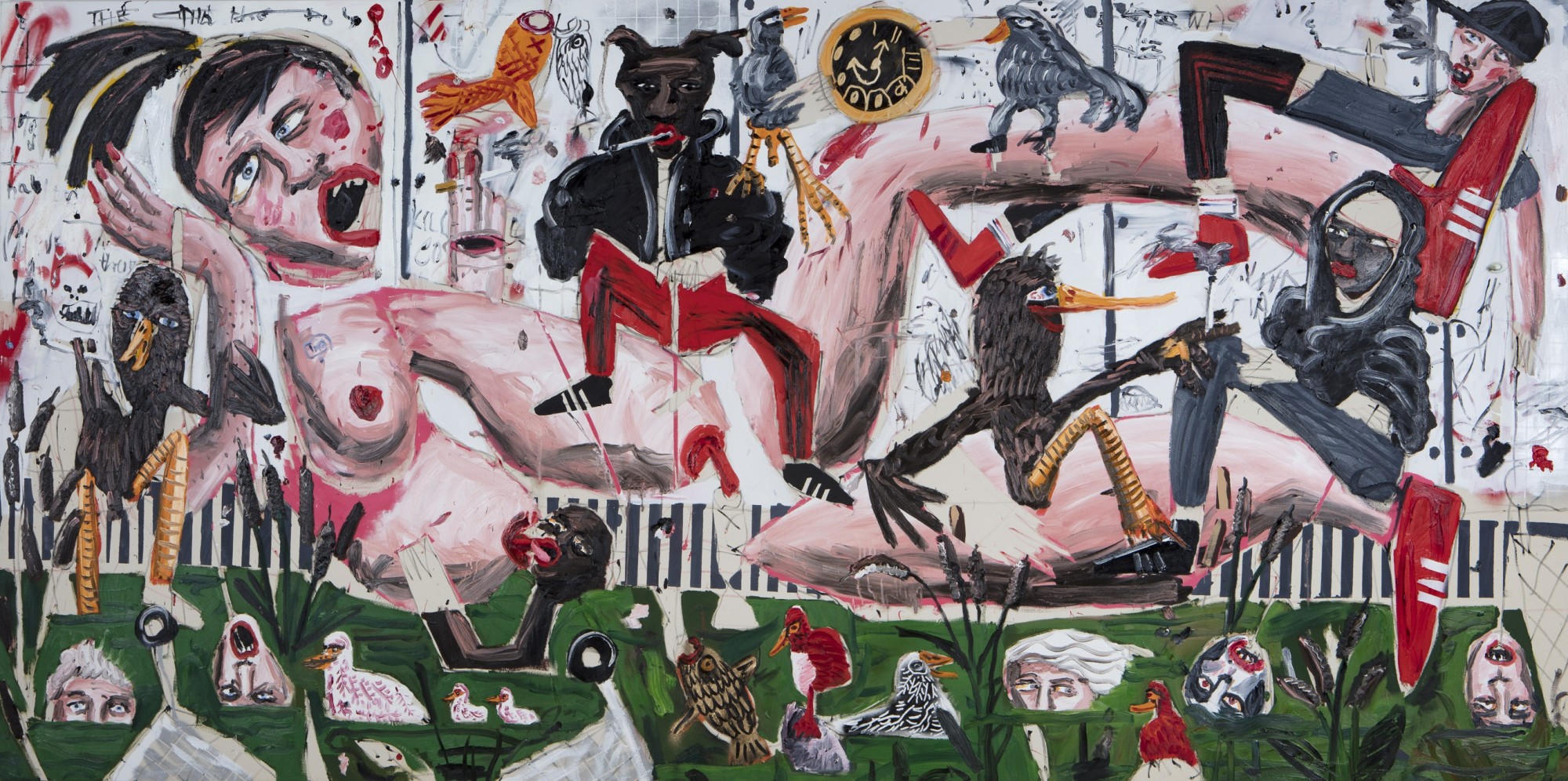
Dale Lewis: Devil's Juice, 2017 - Oil, acrylic and spray paint on canvas, 200 x 400 cm
The story of painting has become, in large part, the story
of its response to other media, especially photography. That used to lead to
questions about whether painting would survive, but we seem to have got
beyond that. Now the obvious question is how it relates to the online world and
the proliferation of social media. Facebook, for example, started in 2004 so children
born this century will have been interacting online since childhood. No doubt
that will affect the art their generation produces, but what of artists already
at work? Some painters have responded directly, for example Richard Prince and
Michael Williams. But indirect approaches are also possible. Painters have emerged who play an awareness
of the streaming prolixity of images and stories into painterly concerns which
remain equally rooted in day to day life and art history. That yields an approach
which is conscious of the online world but chooses not to foreground it in
formal terms. The result is a fresh form of colloquially-driven narrative. There’s
something of that spirit in Rose Wiley, Ansel Krut, Lisa Yuskavage, Magnus
Plessen, Ryan Mosley, Jana Euler, Katherine Bernhardt, Dana Schutz and Jordan
Kasey, for example.
Perhaps that positioning is most likely for artists in their
thirties: a unique generation, quite probably, for whom the online world is
natural without it having been the dominant part of childhood; and for whom
painting was a straightforward rather than charged choice of medium at art
college, as it wasn’t during the perpetual debates about its status in the
preceding century. The way is open for a painterly post-digital vernacular to
develop, and two of the most impressive in that mode are currently showing in London:
Dale Lewis, who has risen to prominence and gained an international profile over
the past year, at Edel Assanti (‘Fat, Sugar, Salt’ to 10 March) and Emma Cousin,
with her first big solo show at Lewisham Arthouse (‘Leg Up’ to 18 Feb).

Emma Cousin: Running Scared, 2018 - oil on canvas, 190 x 225 cm
Though their careers are at slightly different stages, they
have much in common. Neither can be slotted into the macho-male tradition of
painterly assertion: Lewis is gay, which indeed seems to facilitate a
particular abandon in his depiction of women, on whom Cousin concentrates with
a comparable freedom. Both work at scale so their figures are often life sized,
and Lewis in particular has found his distinctive voice over the last couple of
years at a widescreen horizontal format of 2 x 4 metres. Neither use
photographic sources. Both are open fans of the Renaissance, and you can see it
pretty directly in their work. The underlying composition of Lewis’s works
tends to come from the National Gallery, explaining how he combines structural
clarity with spontaneity. Cousin cites how Pontormo, Tiepolo and Poussin feed
into the shapes of her figures and her choices of colour. Both spent much of
their twenties in the more measured end of the art business, contributing perhaps
to the vertiginous sense in their work of having been freed from constraints: Lewis
was assistant to Raqib Shaw, painting with exacting detail; Cousin worked for the
secondary art dealer Robin Katz. Both concentrate on the figure, whether in
groups or with a dominant individual - though Cousin also operates
synechdotally, using a ‘language of legs’ to stand in for the whole person. Both
make paintings packed with incident and content. There’s an immediate hit, for
sure, but there’s also plenty available to decode. And there’s always a dash of
colloquial wit, boosted by the matching informality of the painterly language.
That often feeds into their titles: Cousin’s Running Scared
repurposes a stock phrase to describe figures who, 'although propelled',
as she puts it, 'remain motionless'; and whatever the juice may be in
Lewis’
Devil’s
Juice – drugs, Southern Comfort or paint? – it’s the cause of a pub brawl
sufficiently gloried in to allow for an orgiastic reading. The ‘action painting’
in that fits how Lewis paints: at speed, straight from the tube while the paint
can be moved around – sometimes completing a painting within one flat-out day -
and preferring to keep a sense of urgency and semi-accidental discovery rather
than ‘tidy up’.
The
big difference lies in the source of their vernacular visions. Both use
the personal to reach the universal, but from different directions.
Lewis is primarily an observer: he generates his multi-figure tableaux,
ordered
by classical principles, from the quick-fire notations he makes around
the
streets. ‘In London’, he says, ‘you only have to take a walk, a bus or a
tube
journey and you’ve seen a whole host of people and scenarios that could
make it
into a painting’. Lewis adds in his own memories, often from childhood,
of what
affected him emotionally. Sometimes he’ll appear himself, in that
remembered
role, but I read him as outside looking in: onto the social and
geographical
scene around him, onto his own past. Cousin, in contrast, inhabits her
characters. They’re not self-portraits as such, but they do present the
inner experience
of being a woman in society now – how it feels to be in a social female
body - so that they take on a common relevance.
Let’s look at a couple of paintings from each...

Dale Lewis: Club Tropicana, 2017 - Oil, acrylic and spray paint on canvas, 200 x 400 cm
Lewis’ most recent paintings originate in his daily walk
through London’s East End, from his flat in Leyton to his studio in Bow. Here
we’re in Morrison’s supermarket, posited as a scene of exotic ethnic and
culinary diversity. Lewis has fun with the pineapple, creamy avocado, fried
eggs and a goat’s head (a.k.a. ‘Hoxton Chicken’, from when Hoxton was a poor
area). He playfully imports an
upside-down child from the playground, and a more disturbing figure who seems
unaware of her exposure. It builds to an upbeat view of how to get on with life
in the face of deprivations.

Dale Lewis: Regent's
Canal, 2017 - Oil, acrylic and spray paint on canvas, 200 x 400 cm
Here Lewis starts from the media story of a murdered actress
who starred in East Enders. Her body was found cut up in the canal, but Lewis’
riff on the gruesome result is clearly inspired by Henry Moore’s way of
dividing a body. Here again, there is
comic detail to relish: the isolated fishermen who, says Lewis, never seem to
catch anything, bits of other bodies floating past the shopping trolleys in the
canal, the pigeons apparently stoned…

Emma Cousin: Peeing at 80, 2018 - oil on canvas, 120 x 120 cm
Set aside the subject and this is a formal winner as tilt
meets stripes a la Daniel Buren meets a device whereby the car’s windows are
delineated but we can see the whole interior. But it is an insistent subject,
its head-on engagement with potential embarrassment arising, says Cousin, from
personal experience when caught short in her favoured outdoor activities such
as climbing and running. Then, despite the deft aiming of the extra yellow
stripe, it would be much simpler to be a man. So ‘Peeing at 80’ can – as Luce
Garrigues proposes to Cousin in the show’s catalogue – be read as a female existential
statement: how can a woman perform the most natural task in a society led at
full speed by men?

Emma Cousin: En Masse,
2018 - Oil on canvas, 190 x 190 cm
En Masse fits various types together: a washing-up-gloved mother, shrinking into a floor of restricted activity as she cradles her baby; a gymnast-come-doll; a booted
submissive; a new age meditator with
trendy blue hair; an over-eater, who arches over the set-up even as she enacts
her own version of ‘having it all’.
Behind a jauntily energetic surface, as society requires, lies a rum set
of choices set up to compete as possible facets of a self.
Monday, 12 February 2018
TRAUMA AND CONSOLATION AT ART ROTTERDAM

Levi van Veluw: Sanctum 1, 2017 - wood, ink 85 x 85 cm
Galerie Ron Mandos, Amsterdam
Art Rotterdam is well presented in the iconic modernist former factory Van Nelle Fabriek and the quality is high. The typical work is relatively restrained: plenty of historically aware abstraction and informative conceptual gambits. Leading Dutch galleries such as Galerie Ron Mandos (above is from an all-blue stand), Martin van Zomeren, Fons Welters and Stigter Van Doesburg had exemplary stands along those lines. The British had a strong presence, with Time Ellis (FOLD) and Tom Dale (Copperfield) having excellent solo shows. I found myself drawn towards work which was as dark as the times of refugees, Trump, Brexit,global warming and North Korean posturing might seem to require, yet at the same time looking for work which took us away from all that with a smile or at least some philosophical acceptance... There's room for ambiguity, but let’s start with stern aspects before moving on to more consolatory works.

Matthew Day Jackson: Approaching American Abstraction, 2017
Grimm, Amsterdam / New York
What would be a black monochrome painting seems to have been kicked in. Not quite so: American artist Matthew Day Jackson blasted it away with multiple rounds from a shotgun. The first time, he says, he had used a gun, leaving him with a very sore shoulder and a remnant which speaks to the need for more gun control in the US. In line with that monumental purpose, it’s a one-off bronze we see, the result of direct hot casting of the original shot-through door.

Marcel van Eeden at Galerie Barbara Seiler, Zürich, Galerie Maurits van de Laar, The Hague and Galerie Zink, Waldkirchen, Germany
Dutch artist Marcel van Eeden hasn’t altered his sources: all from the world prior to his birth in 1965, so building in his own historical insignificance in a paradoxically significant manner. But where he used to convert those to predominantly monochrome drawings which coalesced into narratives, here colour – often period hues from the 1960’s which have subsequently faded – came to the fore, and the unsequenced images have been drawn from computer-spun versions of the originals, creating a vortex effect suggestive of the rush of time and the hole down into which the past gets sucked. The effect was enhanced by his having coordinated three galleries to choose different bright colours to display them on: pink, blue and green.

Rod Barton, London
Plenty of people find that their anxiety sharpened by the intrusive visibility of security and its technologies. The Swedish artist Thomas Hämén gives form to just such fears, seeming to show the sequence whereby an airport wave scanner, rather than generating an image of the body as dressed in transparent clothes, has melted a traveller into toast. Consistent with the scanner’s intended function, it is made on semi-transparent nylon stretch fabric, the material which nylon stockings use to resemble human skin and by doing so conceal its imperfections.

Enrique Ramirez: Barco, 2015
Michel Rein, Brussels / Paris
It isn’t hard to imagine that this boat in the colours of an intense sea stands in for a practice tied to the perils of migration and more, and so it proves: Enrique Ramirez deals with the troubled history along the long coast of his native Chile. He has, for example, shown sails made by his father - who has a sail-making workshop in Santiago - inverted, and bearing the traces of their use. In 2013 he travelled on a cargo ship to make a continuous twenty four day shot of the passage from Valparaíso north along the Pacific coast, through the Panama Canal, and then across the Atlantic to Dunkirk.

Sofia Goscinski : Les Damnés, 2017
unttld contemporary, Vienna
Austrian artist Sofia Goscinski has a complex practice: her ideal viewer is familiar with Franz Fanon's positions on symbolic race reversal and anti-colonialism. That said, no theory is required to be struck by a photograph of a white couple with black masks, and in the male case a black prosthetic penis; or the presence of a rat beneath a chair with a large hole in the seat, representing the possibility that the underclass will leap up and administer a nasty nip to the unprosthetic pallus of any member of the ruling class at rest. I did not sit down.

Jacob Aue Sobol: Untitled # 09 from the series 'Home', 2012
Galerie Wouter van Leeuwen, Amsterdam
The Danish photographer Jacob Aue Sobol has said ‘I photograph people because something about them is beautiful and I want to share a moment with them’ and, though this image is bound to foreground our mortality, that applies most strikingly here. Sobel has roamed the world to put together portfolios famous for capturing communities facing harsh conditions in stark yet intimate black and white tonal range. This image of 89 year old Axel kissing his 99 year old girlfriend Onse, though, was taken in Copenhagen in 2010.

Jessica Lajard: Smokers, 2014-16
Irène Laub, Brussels
Or should that 'lighten up' be 'light up'? The imaginative ceramics of French artist Jessica Lajard included several vases which she made of glazed Jingdezhen porcelain and clay in China, where she studied with master craftsmen who were forever offering her a smoke. Those trails of smoke may not be traditional blue and white decorations – yet they do retain a hint of fiery dragons. The vases’ necks turns to lips, and the only flowers present are cigarettes. I guess I could put this in the dark section, with the floral Vanitas of the still life tradition replaced by the deathly implications of smoking. Go further, and the vases are lungs. But they still made me laugh…

Karen Tang: Magnetic Combo, 2016 onwards
l'étrangère, London
Karen Tang uses the clean colours and shapes of geometric and biomorphic sculpture. Yet just as we wonder how critically nuanced the relationships of form and hue might be, her gallerist Joanna Gemes is liable – as shown – to pluck off a piece. For these are fibreglass elements with magnets, which can be moved around or even between their galvanised steel supports, or as it turned out at Art Rotterdam, attached to the desk and part of the booth’s wall which had metal behind it. The result is by turns futuristic, democratic and subversive – but most obviously fun.

Nikita Alexeev: Dessins dialectiques, 2015
Galerie Iragui, Moscow
Moscow conceptualist Nikita Alexeev, a founder member in 1976 of the group ‘Collective Actions’, says he was in a state of bliss on a Greek beach – swimming, sunbathing, collecting sticks that the sea had tossed onto the shore – when he got to wondering what conversations the sticks would have among themselves, and placed them into groups of three. He imagined the somewhat philosophical triad ‘Why?’, ‘Because’. ‘So what, then?’ and set to work drawing the groups just so. It’s a template you can apply to any matter which may be troubling you.

Sander Breure and Witte Van Hulzen: How can we know the dancer from the dance? Video registration from performance, 2016
tegenboschvanvreden, Amsterdam
Over six months, Dutch artist duo Sander Breure and Witte Van Hulzen choreographed a rotating cast of four actors to mimic twenty minutes of movements typical of commuters awaiting a train at Utrecht’s central station, but to do in unison. That alerted the genuine travellers, whose uploaded phone films of synchronised text checking and the like were edited by the artists to form the work: Breure and Van Hulzen took no footage. The public, it transpired, had not only provided the basis for the work, they had recorded it, too. Moreover actions which were utterly mundane became amusing and curiously uplifting in their new form.

Peter Dreher: from Tag um Tag Guter Tag
Wagner + Partner, Berlin
Every day is a good day to see Peter Dreher’s Day by Day, Good Day paintings of an empty water glass, which he rendered - by day and by night, spot the difference - some 5,000 times from 1972-2015. He demonstrates an ability to accept the flux of the world with equanimity by losing himself in the act of painting, consistent with the Zen maxim of his title - applies here to a block of twenty examples, all 25 x 20 cm.

Among the subsidiary events were a retrospective of Paul Delvaux, showing that his famous work is a small proportion of a rarely-seen - if unconvincing - wider picture; 'Kunsthalle for Music' turned Witte de With into an innovative concert venue with deconstructions of musical traditional popping up unpredictably across two floors; Jacqueline Hassink hunted down and photographed places with no digital footprint (Nederlands Fotomuseum); Walter van Beirendonck installed a riot of masks - from ethnography, art and his home field of fashion - at the World Museum; British artist Anne Hardy installed Rotterdam atmospheres to great effect in the Museum Boijamans Van Beuningen, which led with a show dedicated especially to the works from the collections which are too big to get shown very often (some were great, others you could see why they were let out rarely); and Gary Hill understandably needed plenty of whiskey to get through a 24 hour marathon of interviews with art critics.
~
Sunday, 4 February 2018
BRAFA - LOSING HEADS IN EUROPE
Brussels Antiques & Fine Arts fair (BRAFA), 27 Jan - 4 Feb 2018

Pieter Paul Rubens, Paul de Vos and Jan Wildens: Diana and Nymphs Hunting Deer, c 1635-40 at Klaas Muller, Brussels - 155 x 199 cm
The Belgians have a strong collecting culture, so it makes sense that one of the leading fairs of antiquities and fine art is in Brussels, with 134 substantial stands ranging from ancient to tribal to renaissance and modern art with such specialisms as comics, tapestry and glass also represented, and a rediscovered Rubens collaboration as the star item (he commissioned a landscape from Jan Wildens and animals from Paul de Vos to go with his figures). The closest London equivalent would be Masterpiece, but BRAFA (Brussels Antiques & Fine Arts fair) - which has been running since 1956 - is double the size. French and Belgian galleries predominate, but fourteen other countries are represented. And it looks good, with a different carpet designed each year following a competition for relevant students, and architectural installations of massed flowers.

In light of the ongoing Brexit saga, such a Eurofest might raise the question of whether we've lost our collective British heads. Here are a dozen picks from isolated heads to their absence, to various other bodily curiosities with leg, gut and even navel prominent. I've tried to reflect the considerable variety of the offerings under the restored warehouse complex of Tour & Taxis just north of the centre of Brussels. Africa, in line with Belgian tastes, features strongly.

Antoine Schneck: Nakama, 2012 at Galerie AB, Paris
The French photographer Antoine Schneck has travelled to Burkina Faso, Mali, Ethiopia and Sudan with a white tent, to which he adds a black background, asks the subject to wear a black scarf, and triggers the photograph from outside to isolate the character in identical light without distraction. Digitally enhanced and blown up to over a metre high, Nakama made quite an impact.

Pair of earrings, c. 1880 /1950 at Chamarande, Brussels
Jewellery was well represented, and as my wife likes earrings the curious idea of a coral head on each ear, both with their own diamond earrings in turn, was one of the more appealing possible purchases - though not quite to the extent of €4,900, cheap as that was by BRAFA’s standards. The piece is actually a 1950’s reconfiguration of parts taken from a 19th century Italian necklace.


Yaka Masks at Dideir Claes, Brussells
BRAFA has no ‘best stand’ prize, but a strong contender would have been Dideir Claes for sourcing a dozen impressive Yaka masks from the Congo, all at least 50 years old yet complete with raffia fibres. They’re used for the ritual dances associated with circumcision and coming of age, hence the phallic-tending noses and the variety of sizes, different masks with differing powers being worn as the ceremony progresses. They sold out at around €15-20,000 each.

Egyptian mummy mask eyes, c 500 BC at Porfirius Kunstkammer, Neerijse, Belgium
Here the head, or rather its mask, is merely implied: although precious metals were used for the long-lasting Tutankhamun, the masks buried in Egyptian tombs were often made of wood (but with bronze or stone eyes - which are now often all that remains). They were intended to resemble the deceased subject, albeit with the eyes slightly enlarged, so that the soul could recognise the body and return to it.

Thomas Lerooy: Jef, 2017 at Rodolphe Janssen, Brussels - bronze
Irreverent Belgian artist Thomas Lerooy seemed to be suggesting end times for a certain vision of Belgium, judged by a series in which he out the piss out the Manneken Pis by replacing the iconic child's head, in various poses, with a skull. This was at its most effective when the skull-headed child head his former head in a sort of reverse vanitas, consistent with Lerooy's frequent interest in how, though aware of the briefness of mortal life, many seek to quicken its pace with such questionable choices as heavy drinking,

Le Tirthankara Mahavira, c. 11th century at Gallery Christophe Hioco, Paris - white marble
Ancient statues are often fragmented over time to poetic effect, and there were plenty of examples at BRAFA, This Janist figure stood out though: first, the removal of the head appears deliberate, perhaps the result of thieves hacking away the most easily transportable part of value. Less seriously, one might read the absence as the most radical means, beyond any possible meditation, of emptying the mind...

Wang Du: Post-image 03, 2012 at Albert Baronian, Brussels - resin
One of the crowd pullers was this apparently weird sculpture, which actually has its logic on display: rather as you / see figures cut off in Degas under the influence of photography, Wang Du has made his life-size tableau from a photograph of photographs being taken. It looks much less ‘natural’ than in the source, not being a language we’re used to seeing; and, as the model’s head is sheared away the most prominently, suggests a critique of the photographers’ focus.

André Eijberg at the Patinoire Royale, Brussels
The Patinoire Royale’s backdrop was of three sculptures by the not especially famous Belgian sculptor André Eijberg (1929-2012) against weavings by the veteran Colombian Olga de Amaral (born 1932). Here you can see Secrète, 2000 (bleached beech wood) and Mater,1993 (bronze). Eijberg spoke of releasing his figures from tree trunks or blocks of stone rather than creating them, which makes it all the more curious that all eight examples I found at BRAFA were headless…

Goudji: L’Etonnée, chariot de table à la génisse, 2018 at Gallery Claude Bernard, Paris - silver, jasper, crystal
Now for a head unexpectedly present. Goudji is a Georgian metalsmith and sculptor who married the French ambassador’s daughter and, after a few years’ Cold War stresses, was allowed to emigrate to France in 1974. His striking productions are all usable, even if there’s no obvious reason for a fruit bowl to have a head or wheels, at least you know which way to roll it down the long aristocratic table.

Jan Fabre: The Plundering Herald of Life and Death at Gallery Jamar, Antwerp - beetle wing cases, polymers, stuffed bird
It's no surprise to see the Belgian artist using iridescent jewel beetle shields - they're his signature material over three decades, often in allegorical works pointing up the transformational effects of colonialism and the breaking free of it. Here the title points more towards natural cycles, with quite what effect I'm not sure, but the image of a woodpecker at work on a free-floating leg was one of the most memorable at the fair.

Inuit anorak, c. 1920 at Theatrum Mundi, Arezzo, Italy - seal gut, seaweed, cotton thread, caribou fur, glass beads
This protection from arctic extremes results from a month’s Inuit work: the seal’s large intestine had to be washed, scraped inside and out, then inflated and tied at both ends until completely dry before being cut longitudinally and rolled into tight bundles until ready to be sewn into very light waterproof clothing, big enough to fit over a fur parka. Could that crinkled look, presumably from years spent folded in a pocket, inspire a fashion some day?

Attié Statuette - 19th century at Galerie Ratton, Paris
Moving on from the head, this 19th century wooden statuette from the Ivory Coast is attributed to the ‘master of the pretty breasts’, but I was more struck by the prominence of the belly button, which reflects both its symbolic role a font of family and the local tendency, exaggerated here, to cut the umbilical cord ‘long’ for exactly that reason. In my end was the beginning.
Jewellery was well represented, and as my wife likes earrings the curious idea of a coral head on each ear, both with their own diamond earrings in turn, was one of the more appealing possible purchases - though not quite to the extent of €4,900, cheap as that was by BRAFA’s standards. The piece is actually a 1950’s reconfiguration of parts taken from a 19th century Italian necklace.


Yaka Masks at Dideir Claes, Brussells
BRAFA has no ‘best stand’ prize, but a strong contender would have been Dideir Claes for sourcing a dozen impressive Yaka masks from the Congo, all at least 50 years old yet complete with raffia fibres. They’re used for the ritual dances associated with circumcision and coming of age, hence the phallic-tending noses and the variety of sizes, different masks with differing powers being worn as the ceremony progresses. They sold out at around €15-20,000 each.

Egyptian mummy mask eyes, c 500 BC at Porfirius Kunstkammer, Neerijse, Belgium
Here the head, or rather its mask, is merely implied: although precious metals were used for the long-lasting Tutankhamun, the masks buried in Egyptian tombs were often made of wood (but with bronze or stone eyes - which are now often all that remains). They were intended to resemble the deceased subject, albeit with the eyes slightly enlarged, so that the soul could recognise the body and return to it.
Thomas Lerooy: Jef, 2017 at Rodolphe Janssen, Brussels - bronze
Irreverent Belgian artist Thomas Lerooy seemed to be suggesting end times for a certain vision of Belgium, judged by a series in which he out the piss out the Manneken Pis by replacing the iconic child's head, in various poses, with a skull. This was at its most effective when the skull-headed child head his former head in a sort of reverse vanitas, consistent with Lerooy's frequent interest in how, though aware of the briefness of mortal life, many seek to quicken its pace with such questionable choices as heavy drinking,

Le Tirthankara Mahavira, c. 11th century at Gallery Christophe Hioco, Paris - white marble
Ancient statues are often fragmented over time to poetic effect, and there were plenty of examples at BRAFA, This Janist figure stood out though: first, the removal of the head appears deliberate, perhaps the result of thieves hacking away the most easily transportable part of value. Less seriously, one might read the absence as the most radical means, beyond any possible meditation, of emptying the mind...

Wang Du: Post-image 03, 2012 at Albert Baronian, Brussels - resin
One of the crowd pullers was this apparently weird sculpture, which actually has its logic on display: rather as you / see figures cut off in Degas under the influence of photography, Wang Du has made his life-size tableau from a photograph of photographs being taken. It looks much less ‘natural’ than in the source, not being a language we’re used to seeing; and, as the model’s head is sheared away the most prominently, suggests a critique of the photographers’ focus.
André Eijberg at the Patinoire Royale, Brussels
The Patinoire Royale’s backdrop was of three sculptures by the not especially famous Belgian sculptor André Eijberg (1929-2012) against weavings by the veteran Colombian Olga de Amaral (born 1932). Here you can see Secrète, 2000 (bleached beech wood) and Mater,1993 (bronze). Eijberg spoke of releasing his figures from tree trunks or blocks of stone rather than creating them, which makes it all the more curious that all eight examples I found at BRAFA were headless…

Goudji: L’Etonnée, chariot de table à la génisse, 2018 at Gallery Claude Bernard, Paris - silver, jasper, crystal
Now for a head unexpectedly present. Goudji is a Georgian metalsmith and sculptor who married the French ambassador’s daughter and, after a few years’ Cold War stresses, was allowed to emigrate to France in 1974. His striking productions are all usable, even if there’s no obvious reason for a fruit bowl to have a head or wheels, at least you know which way to roll it down the long aristocratic table.
Jan Fabre: The Plundering Herald of Life and Death at Gallery Jamar, Antwerp - beetle wing cases, polymers, stuffed bird
It's no surprise to see the Belgian artist using iridescent jewel beetle shields - they're his signature material over three decades, often in allegorical works pointing up the transformational effects of colonialism and the breaking free of it. Here the title points more towards natural cycles, with quite what effect I'm not sure, but the image of a woodpecker at work on a free-floating leg was one of the most memorable at the fair.

Inuit anorak, c. 1920 at Theatrum Mundi, Arezzo, Italy - seal gut, seaweed, cotton thread, caribou fur, glass beads
This protection from arctic extremes results from a month’s Inuit work: the seal’s large intestine had to be washed, scraped inside and out, then inflated and tied at both ends until completely dry before being cut longitudinally and rolled into tight bundles until ready to be sewn into very light waterproof clothing, big enough to fit over a fur parka. Could that crinkled look, presumably from years spent folded in a pocket, inspire a fashion some day?
Attié Statuette - 19th century at Galerie Ratton, Paris
Moving on from the head, this 19th century wooden statuette from the Ivory Coast is attributed to the ‘master of the pretty breasts’, but I was more struck by the prominence of the belly button, which reflects both its symbolic role a font of family and the local tendency, exaggerated here, to cut the umbilical cord ‘long’ for exactly that reason. In my end was the beginning.
Subscribe to:
Posts (Atom)
About Me

- Paul Carey-Kent
- Southampton, Hampshire, United Kingdom
- I was in my leisure time Editor at Large of Art World magazine (which ran 2007-09) and now write freelance for such as Art Monthly, Frieze, Photomonitor, Elephant and Border Crossings. I have curated 20 shows during 2013-17 with more on the way. Going back a bit my main writing background is poetry. My day job is public sector financial management.