Tuesday, 28 March 2017

THE OTHER SIDE


THE OTHER SIDE

Curated by Paul Carey-Kent

Silk Room, the House of St Barnabas, 1 Greek St, Soho Square, London

By appointment via art@hosb.org.uk 5 Jan - 23 June 2017 -
all works for sale

https://hosb.org.uk/the-collective/#art_room

Launch evening 20 January, 6-9 pm, RSVP required

All works for sale - enquiries via HoSB as above or paulcareykent@gmail.com


We always wonder: what's happening on The Other Side?  First, perhaps, we'd better sort whether were looking in or out. The Silk Room has an attractive window of its own, but Aglaé Bassens gives us more. Are we the looker in or the subject of the gaze? And - if the former - what do we see? Martine Poppe explores our interaction with the camera from the other side of the pond. Emma Cousin, in a different avoidance of the full view, is currently concentrating on legs - and on the other side of this room's potential uses, as a place of meeting, eating and dancing. As indeed, does Jane Hayes Greenwood. Her figures seem to be the other side of flesh and blood - more objects, diagrams or images of images than people, though that doesn't seem to restrict their appetites. All in all, then, it's a puzzle to know where to look and what to make of the characters we find in this pattern-heavy room of four representational female painters, just the other side of the real, perhaps, and just the other side of the wall which divides them from nine male abstractionists tackling the Bazalgette's rich red. Which other side, you might ask, are you on?


Emma Cousin


Dinner party, 2016

Oil paint on canvas - 100 x 160cm

Emma Cousin (born Dewsbury, 1986) is currently in residence at Wimbledon College of Art and co-organises the curatorial platform Bread and Jam. Her paintings have recently moved from quirkily spinning off a variety of homespun narratives - often with a lively awareness of the body's contingencies - to concentrate on charmingly eccentric explorations of our lower limbs in particular. Cousin's work has an immediate force of personality: even without the benefit of faces, you sense the artist behind them. They have the energy and some of the moves of cartoons without looking at all like them. The conversational titles - Cousin is also a poet of some vim - cue you in to everyday phrases which, together with their pictorial retelling, make up a freshly minted 'language of legs' (in which 'business' is spelt 'beesknees'.).


Cutting a Rug, 2016

Oil on canvas - 120 x 100cm


Beesknees, 2016

Oil on canvas - 120 x 100cm
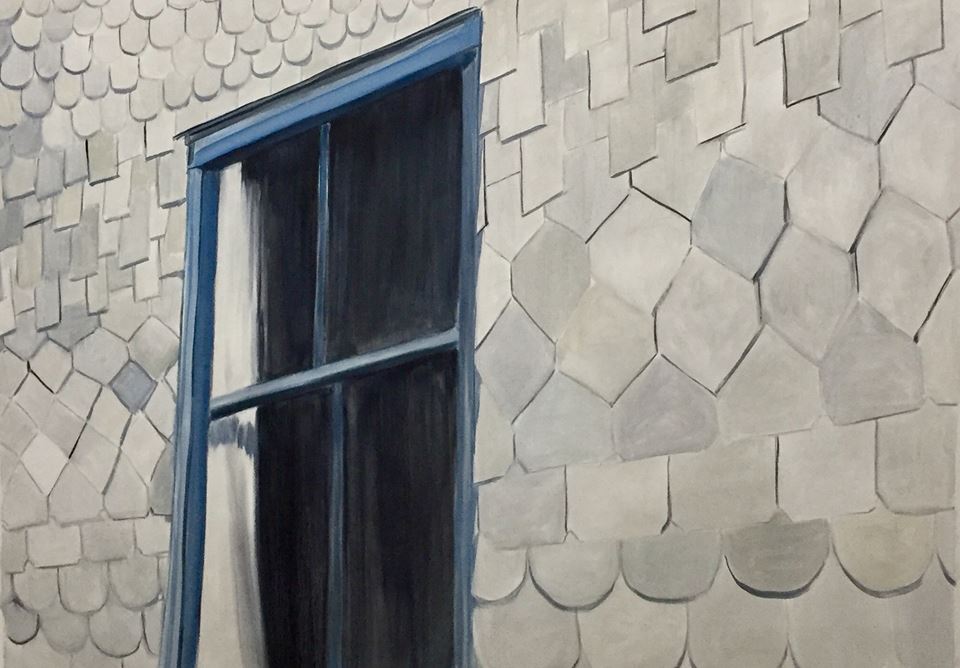

Aglaé Bassens


Scaling Up, 2016

Oil on canvas - 170 x 130 cm

Franco-Belgian Aglaé Bassens (born Mons, 1986) has a way of making something out of nothing by gracefully uncovering the atmospheric melancholy in such 'non-subjects' as empty fish tanks, shirts and sofas so that, in her words, the paintings 'oscillate between presence and absence, the revealed and the concealed, the available and the inaccessible'. Like Poppe, she paints much less objectively than a cursory glance suggests, as her characteristically long, swift strokes bring character to the would-be-minimal. For 'The Other Side' Bassens uses apparently viewless windows and contextless curtains to both reflect on the flatness of the pictorial canvas surface versus the depth of illusion of a painted image, and to comment on how we divide space and create boundaries both physically and socially.


Painting On The Fence, 2016

Oil on canvas - 90 x 45 cm


Exclusive Geometry, 2016

Oil on canvas - 61 x 92 cm


It's A Bit Thin, 2016

Oil on canvas - 45 x 35 cm


Jane Hayes Greenwood


Strung Out, 2016
Acrylic and oil on linen - 55 x 45 cm

Jane Hayes Greenwood (born Manchester, 1986) is the Founding Director of Block 336, an artist-led project space and studio in Brixton and a Fine Art tutor at City & Guilds of London Art School. Like Cousin, she responds directly to the presence of a dinner table in the Silk Room. That suits the recent development in her work from exploring the nature of objects and our relations to them, to feeding gastronomic and erotic imagery through a distorting lens, drawing our attention to sex and food as parallel areas of consumption.  There's something logical yet comic about the way she sets these two appetites in dialogue,  exploring them via their cultural representations -  and makes us wonder, through sly art historical references, just where our desire for aesthetic experience fits in. 


A Sweet Tooth, 2016

Acrylic and oil on linen - 120 x 90 cm


Eat Your Greens, 2016 
Acrylic and oil on linen - 120 x 90 cm


How Does Your Garden Grow, 2016

Acrylic and oil on linen - 55 x 45 cm

Standing In Position, 2016
Acrylic and oil on linen - 55 x 45 cm

Martine Poppe


A little paradoxically, Martine Poppe (born Oslo 1988) explores the impact that the new millennial ubiquity of photography has on our lives by using alluring painting techniques to negotiate between the mechanical and handmade. She has previously veiled the surface by painting opalescently on polyester restoration fabric, so turning the underlying image ghostly. Here, noticing how behaviour can change when a group of people realise that photographs are being taken, she supplies 'before' and 'after' shots she took of a voter and a protest group around the recent US presidential election. They typify individual and social engagement with both image-making and politics. In line with that more direct engagement, Blue and Brown combine photographic ink transfer and paint on the same surface, ramping up the immediacy.


Blue2016

Oil and ink on taffeta - 160 x 110 cm


Brown, 2016

Oil and ink on taffeta

Installation views


At the launch event 20 Jan:


Sunday, 12 March 2017

TONY CHARLES: UNPAINTING

 
TONY CHARLES: UNPAINTING

Platform A Gallery, Middlesbrough: 10th March - 21st April

Curated by Paul Carey-Kent


Unpainting (Formally Dressed) - gloss paint and resin on aluminium, 244 x 122cm
       
  
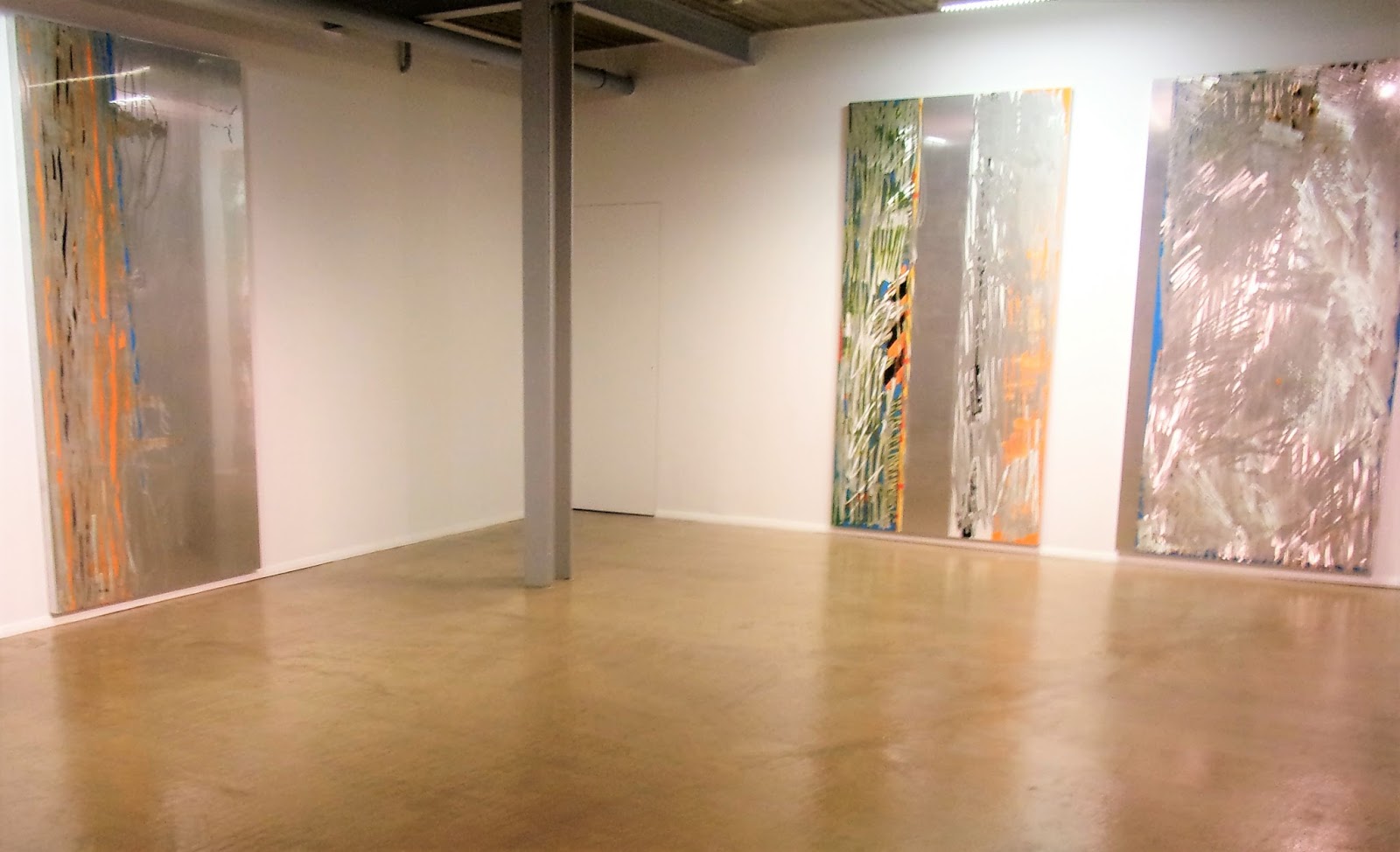
My guess is when you walk in to Tony Charles’ show at Platform A, you will think it is made up of painting and sculpture. You’d be right, but the twist is that you'll probably have them the wrong way round.


Unpainting (Informally Dressed)
           

Let's look at the walls of apparent paintings first.  In fact, Charles points to the contradiction by calling them 'unpaintings'. He takes the standard industrial 8 ft x 4 ft size of aluminium panel and paints them with industrial gloss using the narrow range of simple shapes and clear colours typically found on  signage. That’s the painting stage done with.  He then sets about scraping off the paint with an angle grinder. Afterwards, he applies a layer of resin, which heightens the colour and the reflectiveness through which the works catch the light and respond to its shifts. Typically, Charles gives himself a set time to abrade a given panel with the apparent aim of scraping off all the paint. He's only ‘succeeded’ once to date, but often gets close. Paradoxically, though, the act of removing the paint leaves marks which have a far more painterly aspect than the original flat application of the gloss paint itself. So it's the removal of paint which makes them look like paintings rather than signs, but the results are arguably objects rather than paintings[i].  Moreover, the panels have a substantial materiality, the abrasions are themselves a subtle relief, and Charles’ mark-making often implies that he’s working on a three dimensional I-beam, with its flanges and web described by differing directionalities of the grind marks. Overall, then, there’s enough three dimensionality and objecthood in play to tip the unpaintings into sculptural territory.


Still Life Unpainted (2)

There's a complementary logic at play in the apparently sculptural work Still Life Unpainted 2, which consists of ten aluminium gas bottles, the space available to them indicated by wooden rods. These started life as fire extinguishers, and again Charles has scraped away the paint, in this case entirely so.  We are left with three-dimensional objects of gleaming metal, but still Charles categorises these as paintings. How so? First, the removal of paint again leaves painterly striations; we can recognise the bottles as a classic still life subject, as in the paintings of the Dutch Golden age and through to Morandi [ii]; and the outlining wood suggests both a table on which the bottles can be placed and a frame if we look at the bottles as forming a painting (the ‘unpaintings’, in contrast, lack the traditional frame).  Moreover, the outcome reminds me of scaled-up tubes of paint, triggering the thought of another time when an industrial process had a particularly significant artistic effect: the 19th century trend towards painting en plein air, which facilitated the development of Impressionism, was made possible by the invention of the tubes which enabled paint to be transported conveniently to external sites.


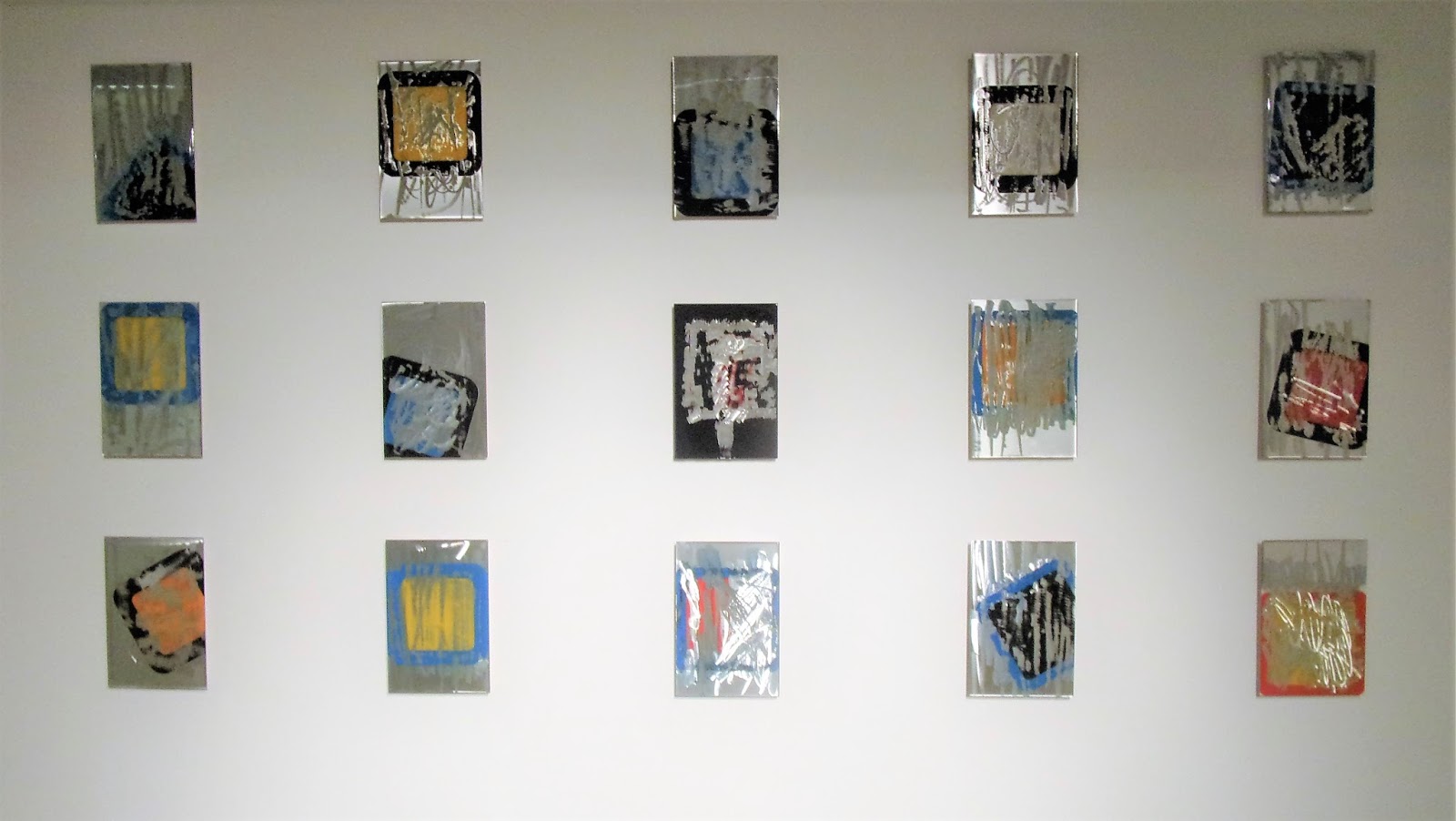
Fettling Series 1-14 and Dog Removal (centre), all 30 x 20cm
The painterly language of scraping off paint, though it derives from the utilitarian construction and cleaning processes for making and maintaining machinery, proves surprisingly varied. Different movements and repetitions of the angle grinder build up distinctive patterns and rhythms akin to brushmarks; and while Charles might naturally use a big grinder (and disc) on a big work and a small one on a small work, keeping the marks proportionate to scale, he can also reverse that expectation. There is no mixing of colours, but the drag of the disc causes a sort of 'uncolouring' in some places, which leads to dirtier or more pastel-like patches. The process also gives Charles two separate chances to vary his compositions: through the initial painting process, and in the subsequent unpainting. Thus for example, the underlying geometry remains very visible in Fettled Section & SIgn, which has echoes of Barnett Newman’s use of the vertical ‘zip’, whereas little paint remains on Informally Dressed. Fettled Pour lies in between, and has some affinity with the staining of Morris Louis. Halving the standard industrial size encourages a squarer format - which Charles tweaks in Dressing Down by stacking two squares. And the combination of several small works – which echo a large panel by covering the same total wall area – makes explicit the general tendency of Charles’ practice to set up and then deconstruct the modernist grid.

All seems good, then: there’s no shortage of visual allure; our expectations are elegant and enjoyably reversed; and viewers can see themselves reflected to some extent, so pulling them into the work and the visible performative traces of its making. Maybe that's enough, but it’s also possible to bring a wider social commentary into play.


Unpainting (Fettled Section and Sign)
      
Charles, born in Cyprus, was the son of a soldier. His first memory is of the change in light and atmosphere when his family moved from their subsequent Maltese posting to Middlesbrough. Despite a hankering for Art College, Charles was apprenticed into the steelworks at South Bank as a welder, plater and boilermaker, staying for sixteen years. Now, as if yearning for the Mediterranean as well as the visual culture he has found as artist, teacher and gallerist, Charles brings dancing light to dull metal and an industrial process to artistic practice.  He was originally inspired by the marks accruing on table-tops on which metalwork was carried out, and terms for grinding metal – dressing and fettling – appear in his titles. Those words also have everyday, non-industrial usages which enable Charles to inject humour while emphasising the links between the two worlds. Those connections are rarely made so integrally to the art and life as in Unpainting. The British steel industry is, of course, in long term decline, and perhaps there is a mournful aspect to that intersection: the pre-scraped originals evoke signage, hence meaning and function – just what’s been scraped away from so many traditional industries.  More optimistically, service and creative businesses might fill that void, so one might take Charles’ bridging of the divide as an illustrative enactment of what needs to happen. Either way, what emerges is generated out of a notably rounded engagement with society.


An ideal experience of modern art might go as follows: you’re drawn in by a distinctive aesthetic, but baffled – just what are you looking at? Having worked that out, you’re entertained a fair while by its paradoxes, before realising that there may be deeper messages to ponder... That turns out to be a rather exact description of Unpainting,


Installation shots


From the opening on 10 March


[i] In that they join a distinguished post-modern canon of ‘paintings without paint’: the many current practitioners include Roger Hiorns, DJ Simpson, Sergei Jensen, Daniel Lergon, Gedi Sibony, Mark Bradford, Auturo Herrera, Richard Tuttle, Rudolf Stingel, El Anatsui and Beat Zoderer. Going back a little, Charles’ removal as a means of painterly mark-making also compares with how the affichistes (Haines, Villeglé , Dufrêne, Rotella) exploited the partial ripping off of layered posters in the 1960’s.

[ii] Morandi is a touchstone for Charles, who might be seen as reversing the Italian’s approach. Morandi applied paint to the vases, jars and bottles, the better to foreground the variations in tone which he wanted to achieve: so he painted both the object and the ground, which were separate in his work. Charles removes paint from his unified object and ground and ends up with something which can, nonetheless, be classified as a ‘still life painting’, just like Morandi’s.


Wednesday, 8 February 2017

BILBAO GONGS AND BONGS

I just spent 30 hours in Bilbao, mostly focused on the opening of Abstract Expressionism at the Guggenheim Museum on the evening of 2 Feb, but the city has plenty else of interest, some good, some not so good...

Most Loved


Cloaked in titanium to appropriately fish-scale effect, the Guggenheim Museum  opened in 1997 with 11,000 m2 of exhibition space distributed over nineteen galleries. Everyone adores it - especially, perhaps, the 5,000-odd locals whose jobs result indirectly from its effect as a beacon for the economics of cultural rejuvenation.  When I downloaded my various photos of Gehry's masterpiece, this one turned out include a cyclist couple who'd evidently taken the love on a stage from the architecture...


 __________________

Least impressive Richard Serra


Richard Serra says it takes an hour to experience fully the walk around and within his seven sculpture installation The Matter of Time (1994–2005) at the Guggenheim. A few seconds is enough to stroll around the Museum of Fine Arts’ Five Plates Counterclockwise Pentagon, 1987, which I imagine seemed quite a big deal itself when installed.  


__________________


Most Curious Sculptural Objects


All along the estuarine banks of the  Nervion River are tall structures founded on corten steel. Are they a response to Serra? No, they are surprisingly substantial lighting for the local fishing boats, and have been there far longer than the American heavy sculptor (who’s father, incidentally, was Spanish). Note the small dog, we'll come back to that. 

__________________

Biggest Show

In London, the first major European survey of Abstract Expressionism since 1959 was a triumph of loan brokering diluted by under-representation of women and poor presentation. At the Guggenheim it looked plain great, even if Mitchell and Frankenthaler got no extra inclusions. Perhaps Clyfford Still (see Spanish sample above) still had the biggest total impact: it was Peggy Guggenheim who first showed him in New York, now here he was in force in her Uncle Solomon's place. And if, Still aside, I were to choose one painting, how about Andrus, 1961, Franz Kline's late turn to colour just before his untimely death at 51 prevented him exploring  its electric possibilities  more fully.

_________________


Most Traumatic Echo of the City


The trees in Bilbao tend so severely towards the minimalist, at least in February, that most are reduced to humanoid stick-ciphers, many to little more than an apparent V-sign to passers by.  One of the Guggenheim’s excellent subsidiary shows was of Albert Oehlen: it included several paintings  using his long-running tree motif. Untitled, 2013, exploits Oelhen’s accidental discovery that he liked painting on aluminium. The series uses magenta, he says, as ‘a hysterical colour, somehow – to me they look like psychopathic human trees’. 


__________________


Sparsest Hang


The Guggenheim’s spaces are very large, so to see one containing just one painting per wall was striking: the three fully available walls were occupied by exceptionally wide horizontal format works by Rauschenberg, Rosenquist and Warhol. One Hundred and Fifty Multicolored Marilyns, 1979, is well over ten metres wide. It’s a dark, obsessive and gestural reversal reprise of the  icon, making it seem all the more emotionally engaged with its creator’s thoughts of his own death.

__________________


Most Double-Edged Echo of the city


Strolling around Bilbao, I noticed was that the Basques love small dogs – I lost count of the poodles and chihuahuas. So perhaps it makes sense that Puppy, 1997 - Koons’ iconic West Highland terrier made of bedding plants - sits outside the Guggenheim, mixing up topiary, dog breeding, sentimental greeting cards and art. On the other hand, its scale (43 feet tall) seems to cock something of a snook at the local preference for miniatures.


__________________

Best View Through A Public Sculpture


Notoriously fiery artist and theoretician Jorge Orteiza (1908–2003) spent 1935-47 in South America either side of his Basque years, and taught the more famous Chillida  (but fell out with him for 30 years from 1967 before a late reconciliation). Orteiza is known for his small works, well represented in the Museum of Fine Art. However, this public sculpture Ovoid variation on the emptying of the sphere  is a rather successful later scaling up of a 1958 sculpture which makes use of his characteristic interest in emptied forms to  ‘capture’ the town hall's tower from some angles.


 __________________


Most Famous Basque Artist


Eduardo Chillida (1924 - 2002) is probably the answer to the quiz question: which famous artist was the best footballer?He kept goal for Real Sociedad before knee injuries ended his career. There’s plenty of his work around Bilbao and in its museums. The Guggenheim's alabaster How Profound Is the Air, 1996, shows him, like Orteiza, as an architect of the void.  it contrasts nicely with Meeting Place IV, 1973, a more opened-up hanging structure of cast concrete.


__________________
 

Third Best (or Least Bad?) Basque Artist


Blbao’s Museum of Fine Art features a comprehensive overview of Basque artists, If, like me before my visit, you could only ascribe Chillida and Orteiza to that category with any confidence, then that full overview pretty much explained why no-one else has come to prominence. All the same, I was somewhat drawn to Francisco Irurrino, (1864-1924) who travelled to Morocco with Matisse and arrived at a tightly organised blend of Impressionism and Fauvism. The vibrant Nudes (Women Dancing in a Ring), 1916-18, seems, interestingly, to construct a landscape space around the figures rather than setting the figures in the landscape.


__________________


Unexpected Masterpiece


Sticking with nudes in the Fine Arts Museum, Belgian Martin de Vos (1532-1603) excels in The Rape of Europa, c 1590, in which the Phoenician princess, who plays on the shore in the background, seems very relaxed about being abducted by Jupiter in the form of a bull. De Vos, who went to Italy with Pieter Brueghel the Elder and worked in Tintoretto’s studio, combines flowing colour movement with pellucidly lit flesh.

__________________

Most Ludicrous Frame
            

The Museum of Fine Arts’ also holds  Young Woman, 1914 by the Valencian artist Joaquín Sorolla (1863-1923): a modest portrait totally dominated by its frame, which seemed to be echoing the subject's flowers with an extravagance out of all proportion.  Perhaps a deeper point was being made, but I couldn’t think what it might be…
__________________

Best Shows Not Seen


I was a couple of days too early for what sounded an impressive survey of intimacy in Renoir. No matter, I decided to explore the city's small clutch of commercial galleries before catching the evening flight - only to find that the standard gallery hours are 11-2 and 5-9, which makes plenty of sense but caught me out. I did catch a glimpse of Isabel Garay's exhibition of sculpture through the door of the Vanguardia galleria, and it looked good enough to wish it had been more fully viewable.


About Me

My photo
Southampton, Hampshire, United Kingdom
I was in my leisure time Editor at Large of Art World magazine (which ran 2007-09) and now write freelance for such as Art Monthly, Frieze, Photomonitor, Elephant and Border Crossings. I have curated 20 shows during 2013-17 with more on the way. Going back a bit my main writing background is poetry. My day job is public sector financial management.

Followers